Nikon D850 Review: Full Specifications, Features, Performance, Pros and Cons
The Nikon D850 is a professional full-frame DSLR camera designed for photographers who want a combination of extremely high image resolution, fast performance, reliable autofocus, strong build quality, and excellent versatility. Although the camera was introduced several years ago, it remains an important choice for photographers who specifically prefer the optical viewfinder, handling, and lens ecosystem of a traditional DSLR.
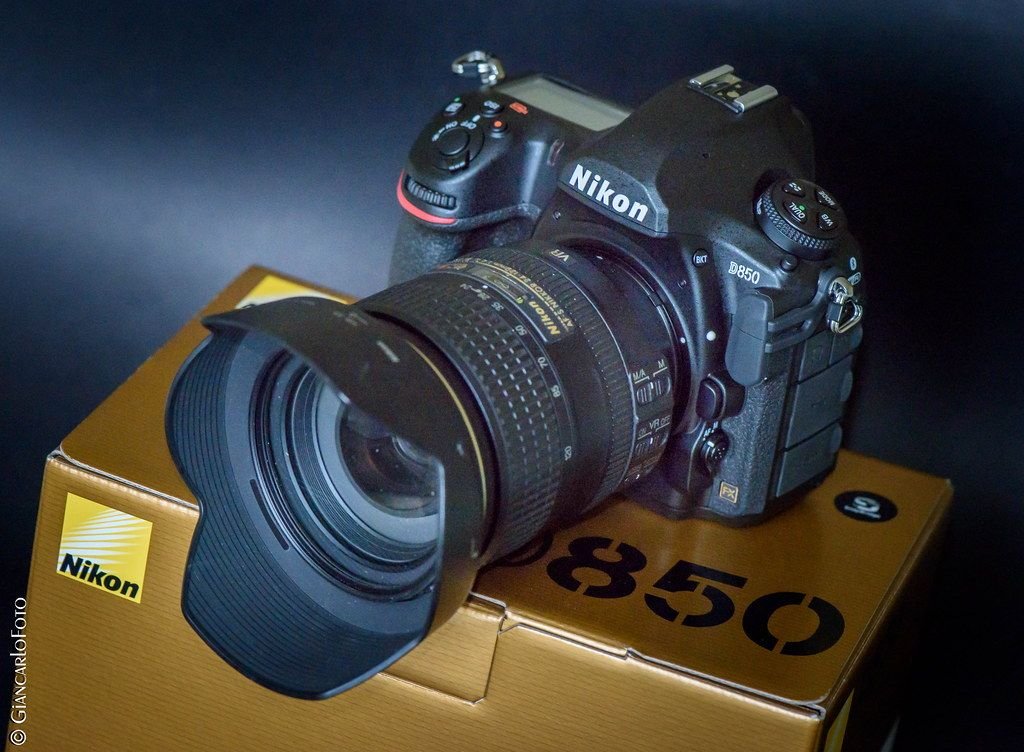
With a 45.7-megapixel FX-format BSI CMOS sensor, 7 frames-per-second continuous shooting, a sophisticated 153-point autofocus system, 4K UHD video recording, and a rugged weather-sealed body, the Nikon D850 was designed to handle demanding photography assignments ranging from landscapes and portraits to weddings, commercial work, wildlife, and sports.
Nikon D850 Overview
The Nikon D850 is a full-frame DSLR that combines high resolution with relatively fast continuous shooting. Its 45.7-megapixel sensor provides a large amount of detail, making the camera particularly attractive for landscape, studio, commercial, architectural, product, and portrait photography.
Nikon uses a backside-illuminated FX-format CMOS sensor without an optical low-pass filter. This design helps the camera deliver highly detailed images while maintaining strong light-gathering performance.
The camera also offers a native ISO range of 64 to 25,600, expandable to an equivalent of ISO 32 and up to ISO 102,400.
Key Nikon D850 Specifications
Feature Nikon D850 Camera Type Full-frame DSLR Sensor FX-format BSI CMOS Effective Resolution 45.7 MP Sensor Size 35.9 × 23.9 mm Lens Mount Nikon F Processor EXPEED 5 Native ISO 64–25,600 Expanded ISO Approximately 32–102,400 Continuous Shooting Up to 7 fps Maximum Shooting Speed Up to 9 fps with compatible battery grip and battery Autofocus 153-point AF system Video 4K UHD 4K Resolution 3840 × 2160 Maximum 4K Frame Rate 30p Display 3.2-inch tilting touchscreen LCD Storage XQD/CFexpress compatibility depending on setup plus SD Wi-Fi Yes Bluetooth Yes Battery EN-EL15-series rechargeable Li-ion Approx. Body Weight 915 g Body Material Magnesium alloy/carbon-fibre construction Lens System Nikon F-mount NIKKOR lenses
Specifications can vary slightly depending on firmware, accessories, and regional product information. Nikon lists the D850’s effective resolution at 45.7 megapixels and its FX-format sensor at 35.9 × 23.9 mm.
45.7MP Full-Frame Sensor
One of the biggest reasons photographers choose the Nikon D850 is its high-resolution sensor.
The 45.7MP FX-format sensor can produce highly detailed photographs with plenty of room for cropping. This can be particularly useful for photographers who need to create large prints or crop an image while retaining substantial detail.
The sensor is also backside illuminated and does not use an optical low-pass filter. Nikon designed this combination to maximize fine detail and improve light-gathering efficiency.
For landscape photographers, this high resolution can be especially useful because fine textures such as rocks, leaves, buildings, mountains, and architectural details can be captured with excellent clarity.
Image Quality
Image quality is arguably the D850’s strongest feature.
At low ISO settings, the camera can produce exceptionally detailed images with strong tonal information. The ISO 64 base sensitivity is particularly useful for landscape and studio photographers who want maximum dynamic range and clean files.
The high pixel count also gives photographers considerable flexibility during post-processing. A photographer can crop an image significantly and still retain enough resolution for many applications.
For professional commercial photography, product photography, fashion, architecture, and landscape work, the D850 remains a very capable camera.
Nikon D850 Autofocus System
The Nikon D850 uses a sophisticated autofocus system with 153 AF points, including 99 cross-type sensors and a dedicated autofocus processor. Nikon designed this system for accurate focusing across a wide variety of shooting situations.
The autofocus system can be useful for:
- Wildlife photography
- Sports photography
- Wedding photography
- Portrait photography
- Fashion photography
- Events
- Moving subjects
- General professional photography
The camera can also focus in very low-light situations, with Nikon specifying autofocus sensitivity down to approximately -4 EV in certain configurations.
Continuous Shooting Performance
Despite its very high 45.7MP resolution, the D850 is capable of shooting at approximately 7 frames per second at full resolution.
When paired with the optional MB-D18 Multi-Power Battery Pack and a compatible high-capacity battery, the camera can reach approximately 9 frames per second at full resolution.
This makes the D850 more versatile than many people might expect from a high-resolution DSLR.
For example, wedding photographers can use continuous shooting to capture important moments, while wildlife photographers can use burst shooting to record fast-moving subjects.
Nikon D850 Video Features
Although the D850 is primarily known as a photography camera, it also provides strong video capabilities.
It can record 4K UHD video at 3840 × 2160 resolution, with available 30p, 25p, and 24p frame rates. It can also record Full HD footage at higher frame rates.
The 4K capability makes the camera suitable for:
- YouTube videos
- Interviews
- Short films
- Product videos
- Travel videos
- Wedding videos
- Documentary-style projects
However, photographers whose main priority is modern video production may find newer mirrorless cameras more convenient because newer systems often provide more advanced video autofocus, stabilization, codecs, and higher frame-rate options.
Build Quality and Weather Sealing
The D850 has a professional-oriented body designed for demanding use.
Nikon describes the camera as having a rugged construction using magnesium alloy and carbon-fibre materials, along with extensive sealing around joints and seams to help protect against dust and moisture.
This is useful for photographers who frequently work outdoors.
The camera is suitable for demanding environments such as:
- Mountains
- Outdoor weddings
- Wildlife locations
- Travel photography
- Landscape photography
- Commercial assignments
- Long shooting sessions
Weather sealing does not mean the camera is waterproof. Appropriate protection should still be used during heavy rain or extremely wet conditions.
Nikon D850 Display
The camera features a 3.2-inch tilting touchscreen LCD.
The tilting design can make shooting from unusual angles easier than with a completely fixed screen. It can be helpful for low-angle landscape shots, overhead compositions, and certain video setups.
The touchscreen also makes navigating some camera controls and reviewing photographs more convenient.
Battery Life
Battery performance is another strong point of the Nikon D850.
Nikon lists approximately 1,840 shots per charge under CIPA testing conditions for the relevant battery configuration. Actual battery life can vary depending on temperature, autofocus usage, live view, video recording, image review, wireless connectivity, and other settings.
For professional photographers shooting weddings or long outdoor sessions, carrying an additional battery is still recommended.
Storage and Memory Cards
The D850 was designed with professional workflows in mind and supports high-speed memory storage.
Depending on the configuration and firmware generation, photographers can use supported XQD/CFexpress-type media alongside an SD card.
Using fast and reliable memory cards is important when shooting large 45.7MP RAW files or long bursts.
For professional work, it is also a good practice to carry multiple cards and regularly back up important photographs.
Nikon F-Mount Lens Compatibility
The D850 uses Nikon’s F-mount, giving photographers access to a huge range of NIKKOR lenses.
This is one of the major advantages of choosing the D850.
Photographers can choose from lenses designed for:
- Landscape photography
- Portrait photography
- Wildlife
- Sports
- Macro
- Architecture
- Product photography
- Street photography
- Weddings
A high-resolution camera such as the D850 can particularly benefit from high-quality lenses because the sensor is capable of recording a large amount of fine detail.
Nikon D850 for Landscape Photography
The D850 is an excellent option for landscape photographers.
Its combination of high resolution, low base ISO, wide dynamic range, and full-frame sensor makes it well suited to capturing detailed outdoor scenes.
Photographers can use wide-angle lenses to capture large landscapes and then crop their photographs during editing when necessary.
The camera’s rugged construction is also useful for photographers who regularly travel to outdoor locations.
Nikon D850 for Portrait Photography
The high resolution of the D850 can be particularly useful for professional portraits.
With an appropriate NIKKOR portrait lens, photographers can achieve detailed facial rendering and attractive background separation.
A high-quality prime lens such as an 85mm-class lens can be a good match for traditional portrait photography, while a 70-200mm telephoto zoom can provide additional flexibility for professional portrait and event work.
Because the camera produces large files, photographers should also be prepared for increased storage requirements during long sessions.
Nikon D850 for Wildlife Photography
Wildlife photographers can benefit from the D850’s high resolution and autofocus system.
The 45.7MP sensor gives photographers considerable cropping flexibility, which can be useful when photographing animals from a distance.
The optional battery grip can also increase the maximum continuous shooting speed to approximately 9 fps with the appropriate battery setup.
A fast telephoto lens is highly recommended for serious wildlife photography.
Nikon D850 for Wedding Photography
The D850 is also well suited to weddings.
Its high resolution allows photographers to capture detailed portraits, group photographs, decorations, ceremonies, and candid moments.
The camera’s silent Live View photography mode can be useful in situations where minimizing camera noise is important. Nikon specifically highlights applications such as weddings, golf, and press conferences for silent shooting.
For professional wedding work, photographers will usually want at least one backup camera body and multiple memory cards and batteries.
Nikon D850 for Studio and Commercial Photography
Studio photographers can take advantage of the D850’s high-resolution sensor.
The 45.7MP output is useful for commercial images where clients need detailed photographs for:
- Advertising
- Product catalogs
- Fashion campaigns
- Magazines
- Posters
- Large prints
- E-commerce photography
In controlled lighting conditions, the camera can produce exceptionally detailed files that provide plenty of room for professional editing.
Nikon D850 Pros and Cons
Pros
- 45.7MP full-frame sensor
- Excellent image detail
- Strong dynamic range
- Low native ISO of 64
- Professional build quality
- Weather and dust sealing
- Advanced 153-point autofocus system
- Up to 7 fps continuous shooting
- Up to 9 fps with optional battery grip and compatible battery
- 4K UHD video recording
- Excellent selection of Nikon F-mount lenses
- Tilting touchscreen display
- Strong battery life
- Excellent choice for landscape and commercial photography
Cons
- Large and relatively heavy body
- DSLR design is less compact than modern mirrorless cameras
- 45.7MP files require significant storage
- No built-in image stabilization
- Video autofocus is not as modern as many newer mirrorless cameras
- The F-mount system is an older lens platform compared with Nikon’s newer Z system
- Professional accessories and high-quality lenses can be expensive
Is Nikon D850 Still Worth Buying?
The answer depends on what type of photographer you are.
If you specifically want a high-resolution full-frame DSLR with an optical viewfinder, the D850 remains an extremely capable option.
It can be an excellent choice for landscape, portrait, studio, commercial, wedding, architecture, and wildlife photography.
However, photographers buying their first professional camera in the current market should also compare the D850 with newer mirrorless cameras. Modern mirrorless models can offer advantages such as electronic viewfinders, more advanced subject-detection autofocus, better video features, in-body stabilization on many models, and newer lens systems.
The D850 makes the most sense for photographers who value its DSLR handling, optical viewfinder, excellent image quality, rugged body, and access to Nikon’s extensive F-mount lens ecosystem.
Nikon D850 vs Nikon D780
The D850 and D780 are both full-frame Nikon DSLRs, but they target somewhat different users.
The D850 provides significantly higher resolution with its 45.7MP sensor, while the D780 uses a 24.5MP sensor.
The D780 can therefore be more practical for photographers who do not need extremely large files, while the D850 is better suited to photographers who prioritize maximum detail and cropping flexibility.
For commercial, landscape, studio, and high-resolution work, the D850 has a clear advantage in resolution.
Nikon D850 vs Nikon D750
The D750 is an older full-frame DSLR with a 24.3MP sensor, while the D850 provides 45.7MP.
The D750 can still be attractive as a lower-cost full-frame option, especially for photographers who do not require extremely high resolution.
The D850, however, offers substantially more resolution, a more advanced autofocus system, a higher-resolution display, 4K video, and newer-generation processing and performance features.
Who Should Buy the Nikon D850?
The Nikon D850 is particularly suitable for:
Professional photographers:
Its high resolution and rugged construction make it suitable for demanding commercial assignments.
Landscape photographers:
The high-resolution sensor and ISO 64 base sensitivity are excellent for detailed landscapes.
Wedding photographers:
The combination of resolution, autofocus, burst shooting, and professional build quality makes it highly versatile.
Wildlife photographers:
The high pixel count can provide useful cropping flexibility.
Studio photographers:
The detailed files are well suited to commercial and product photography.
Serious enthusiasts:
Photographers who want professional-level DSLR image quality can get a lot from the D850.
Who Should Avoid the Nikon D850?
The D850 may not be the best choice if you primarily want:
- A very lightweight camera
- The newest autofocus technology
- Advanced modern video features
- Built-in image stabilization
- A compact travel setup
- A new-generation mirrorless lens system
For those users, a modern mirrorless camera may be a better long-term choice.
Recommended Lenses for Nikon D850
Choosing the right lens is just as important as choosing the camera body.
For landscapes, a wide-angle NIKKOR lens can provide a broad field of view.
For portraits, an 85mm or 105mm-class prime lens can provide attractive perspective and background separation.
For wildlife, a 200-500mm or similar telephoto lens can provide the reach needed for distant subjects.
For weddings and events, a 24-70mm-class zoom and a 70-200mm-class zoom can provide a highly versatile combination.
For macro photography, a dedicated Micro-NIKKOR lens can help capture extremely fine subjects such as flowers, insects, jewelry, and small products.
Nikon D850 Price
The actual selling price of a Nikon D850 can vary considerably depending on the seller, availability, condition, included accessories, and whether the camera is new or used.
Nikon India’s current product page lists an MRP of ₹2,34,950 for the body-only configuration, inclusive of taxes. Buyers should check the latest official price and retailer pricing before making a purchase.
Used-market pricing can be substantially different, so buyers should carefully check shutter count, sensor condition, LCD condition, battery health, ports, memory-card slots, autofocus performance, and overall body condition.
Final Verdict
The Nikon D850 remains one of the most impressive high-resolution DSLR cameras ever produced.
Its 45.7MP full-frame BSI CMOS sensor, excellent dynamic range, professional autofocus system, rugged construction, strong battery performance, and 4K video capabilities make it a highly versatile camera.
Its greatest strength is image quality. Photographers who need detailed files for landscapes, portraits, commercial work, studio photography, architecture, weddings, and wildlife can still get excellent results from this camera.
However, the D850 is a DSLR from an older generation, and photographers looking for the latest autofocus, stabilization, video capabilities, and lens technology should compare it with current mirrorless cameras before purchasing.
For photographers who specifically want a professional DSLR, however, the Nikon D850 remains a highly capable and serious photography tool.
Nikon D850 Quick Rating
Category Rating Image Quality 9.5/10 Resolution 10/10 Autofocus 9/10 Build Quality 9.5/10 Battery Life 9/10 Wildlife Photography 9/10 Landscape Photography 10/10 Portrait Photography 9.5/10 Video 8/10 Beginner Friendly 7/10 Professional Photography 9.5/10 Overall 9.3/10
Frequently Asked Questions
Is the Nikon D850 a full-frame camera?
Yes. The D850 uses a Nikon FX-format full-frame sensor measuring approximately 35.9 × 23.9 mm.
How many megapixels does the Nikon D850 have?
The D850 has 45.7 effective megapixels.
Does the Nikon D850 record 4K video?
Yes. It can record 4K UHD video at 3840 × 2160 resolution, including 30p, 25p, and 24p options.
Is Nikon D850 good for wildlife photography?
Yes. Its high-resolution sensor, advanced autofocus system, and continuous shooting capability make it a strong choice for wildlife photography.
Is the Nikon D850 good for beginners?
It can be used by beginners, but it is primarily designed for serious enthusiasts and professional photographers. Its extensive controls and professional features may require some learning.
Does the Nikon D850 have Wi-Fi?
The camera supports wireless connectivity, including Bluetooth Low Energy and Wi-Fi functionality through its connectivity system.
What lens mount does the Nikon D850 use?
The camera uses Nikon’s F-mount and is compatible with a wide range of NIKKOR lenses.
How heavy is the Nikon D850?
The camera body weighs approximately 915 grams.
Is the Nikon D850 weather sealed?
Nikon designed the D850 with extensive sealing around joints and seams to provide protection against dust and moisture. It should not, however, be treated as a waterproof camera.
Is Nikon D850 still worth buying?
For photographers who specifically want a high-resolution professional DSLR, yes. However, buyers should also compare current mirrorless cameras because they offer newer technology and may provide a better long-term platform for new purchases.