Canon EOS 90D Review: A Powerful 32.5MP APS-C DSLR for Photography Enthusiasts
The Canon EOS 90D is a high-resolution APS-C DSLR designed for photographers who want a combination of excellent image quality, fast performance, reliable autofocus and traditional DSLR handling. With a 32.5-megapixel CMOS sensor, DIGIC 8 image processor, 45-point all-cross-type autofocus system through the optical viewfinder, Dual Pixel CMOS AF in Live View, 10 frames-per-second continuous shooting and 4K video recording, the EOS 90D remains one of Canon’s most capable APS-C DSLRs.
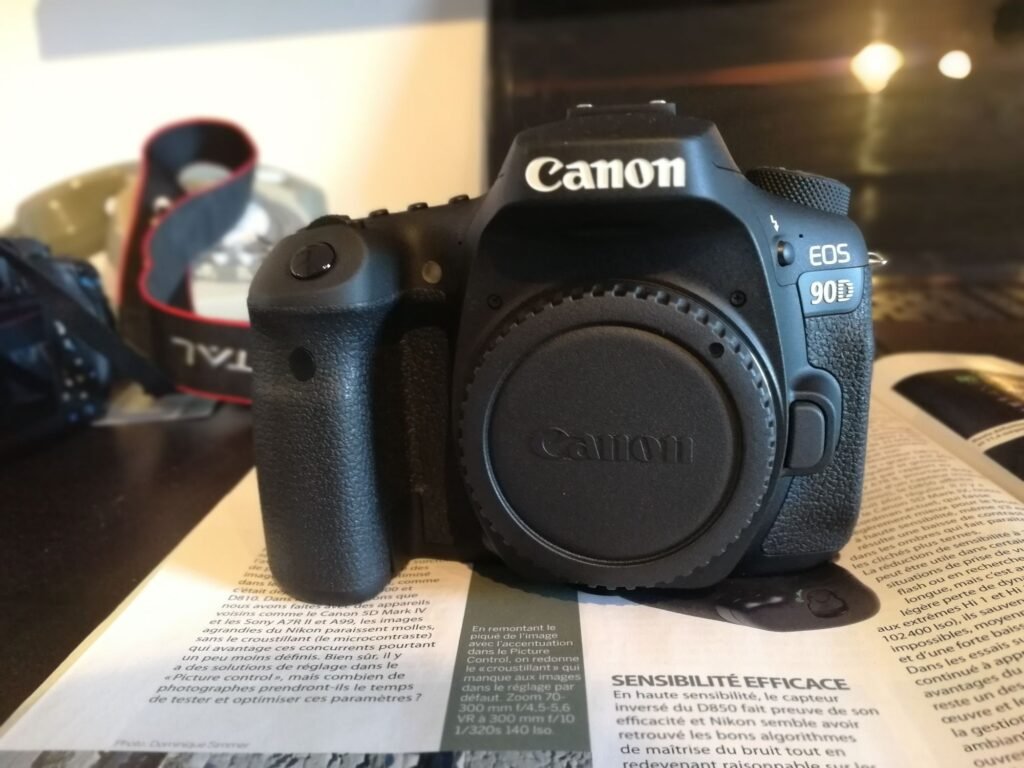
The camera is particularly interesting for wildlife, bird, sports, travel, landscape, portrait and general enthusiast photography. Its APS-C sensor also provides additional reach with telephoto lenses, which can be useful when photographing distant subjects.
Although Canon has shifted its attention toward mirrorless cameras, the EOS 90D remains relevant for photographers who already own Canon EF or EF-S lenses and prefer the optical viewfinder and physical controls of a DSLR.
Canon EOS 90D Overview
The EOS 90D sits in Canon’s advanced enthusiast DSLR range. It was designed as a successor to the EOS 80D and combines a high-resolution sensor with significantly improved processing and shooting capabilities.
Its 32.5MP sensor provides plenty of detail for cropping and large prints. This is particularly useful for wildlife photographers who may need to crop an image after photographing a distant bird or animal.
The camera can shoot at up to approximately 10 fps using the optical viewfinder, making it considerably faster than many traditional enthusiast DSLRs.
Canon also included 4K video, a fully articulating touchscreen, Wi-Fi and Bluetooth connectivity, microphone and headphone connections, and a durable body designed for demanding photography.
Canon EOS 90D Key Specifications
Specification Canon EOS 90D Camera Type APS-C DSLR Sensor CMOS Effective Resolution 32.5 MP Sensor Size Approx. 22.3 × 14.8 mm Processor DIGIC 8 Native ISO Range ISO 100–25,600 Expanded ISO Up to ISO 51,200 Optical Viewfinder AF 45-point all-cross-type AF Live View AF Dual Pixel CMOS AF Maximum Shooting Speed Approx. 10 fps Maximum Shutter Speed 1/8000 sec Video 4K UHD LCD 3.0-inch vari-angle touchscreen LCD Resolution Approx. 1.04 million dots Storage Single SD card slot Connectivity Wi-Fi and Bluetooth Lens Mount Canon EF/EF-S Battery LP-E6N Body Material Aluminum alloy/polycarbonate construction Weather Resistance Yes Weight Approx. 701g with battery and card Microphone Input Yes Headphone Output Yes
Specifications are based on Canon’s published EOS 90D specifications.
32.5MP APS-C Sensor
One of the biggest attractions of the Canon EOS 90D is its 32.5-megapixel APS-C CMOS sensor.
This is a very high resolution for an APS-C DSLR and gives photographers considerable flexibility when cropping photographs.
For example, wildlife photographers often cannot get physically close to their subjects. A high-resolution sensor allows them to crop the image while retaining a useful amount of detail.
The sensor is also useful for:
- Landscape photography
- Wildlife photography
- Bird photography
- Portraits
- Travel photography
- Product photography
- Sports
- Studio work
For photographers who regularly crop their images, the EOS 90D’s resolution is one of its strongest features.
DIGIC 8 Image Processor
Canon equipped the EOS 90D with the DIGIC 8 image processor.
The processor is responsible for handling image data, autofocus processing, continuous shooting, noise reduction and video processing.
The combination of the high-resolution sensor and DIGIC 8 processor allows the camera to maintain fast operation despite its large number of pixels.
ISO Performance
The EOS 90D has a standard ISO range of 100–25,600, with expansion available up to ISO 51,200.
Lower ISO settings generally provide the cleanest images with maximum detail and dynamic range. Higher ISO settings can be useful when shooting indoors, at night or when a fast shutter speed is required.
For example, wildlife photographers may need higher ISO settings to maintain a fast shutter speed when photographing birds in poor lighting.
As with any camera, the highest ISO settings are primarily intended for situations where capturing the photograph is more important than maintaining maximum image quality.
45-Point All Cross-Type Autofocus
When shooting through the optical viewfinder, the EOS 90D uses a 45-point all-cross-type AF system.
Cross-type autofocus points can detect contrast in both horizontal and vertical directions, helping the camera focus reliably on subjects with suitable contrast.
The system is useful for:
- Portraits
- Wildlife
- Sports
- Events
- Children
- Street photography
- Everyday photography
The camera also offers different AF-area selection modes, allowing photographers to choose how much of the autofocus system is involved in tracking or selecting a subject.
Dual Pixel CMOS AF in Live View
One of the EOS 90D’s major advantages is its Dual Pixel CMOS AF technology when using Live View.
This system provides smoother autofocus performance than traditional contrast-based Live View focusing and is particularly useful when recording video or composing photographs on the rear screen.
Canon’s Dual Pixel CMOS AF is especially useful for:
- Video recording
- Moving subjects
- Touch-to-focus shooting
- Low-angle photography
- High-angle photography
- Portraits
The touchscreen allows photographers to select a focus point directly on the display.
10 FPS Continuous Shooting
The EOS 90D can shoot at approximately 10 frames per second when using the optical viewfinder.
This makes the camera particularly useful for action photography.
A fast burst rate can help capture the exact moment when:
- A bird takes off
- An athlete crosses the finish line
- A football player kicks the ball
- A child jumps
- A vehicle passes
- An animal changes direction
The actual shooting rate and buffer performance can depend on shooting settings, subject conditions, file format and memory-card performance.
1/8000 Second Shutter Speed
The EOS 90D offers a maximum mechanical shutter speed of 1/8000 second.
This is useful when photographing fast-moving subjects or using wide-aperture lenses in bright conditions.
For portrait photographers, a fast shutter speed can also make it easier to use a wide aperture outdoors while keeping exposure under control.
Optical Viewfinder
As a DSLR, the EOS 90D provides an optical viewfinder rather than an electronic viewfinder.
The optical viewfinder provides a real-time view through the camera’s lens without displaying a digital preview.
Many photographers prefer this experience because it provides a natural connection with the scene and does not require the photographer to look at an electronic screen while composing through the finder.
The viewfinder is particularly useful for:
- Sports
- Wildlife
- Street photography
- Events
- Portraits
- General photography
3-Inch Vari-Angle Touchscreen
The EOS 90D features a 3-inch vari-angle touchscreen LCD.
The fully articulating design is useful for photography and video from unusual angles.
For example, photographers can tilt the screen when:
- Shooting close to the ground
- Photographing above a crowd
- Recording themselves
- Shooting from a tripod
- Capturing macro photographs
The touchscreen also makes it easier to navigate menus, select focus points and review images.
4K Video Recording
The Canon EOS 90D supports 4K UHD video recording.
This makes it more versatile than many older Canon DSLRs that were limited to Full HD.
4K video is useful for:
- YouTube videos
- Travel videos
- Product videos
- Interviews
- Educational content
- Family videos
- Short films
The camera also provides an external microphone input and headphone output, which are useful for creators who want more control over recorded audio.
For photographers whose main priority is professional video, however, newer mirrorless cameras may provide more advanced video features.
Fully Articulating Screen for Video Creators
The vari-angle LCD is particularly helpful for people creating video content.
When the camera is mounted on a tripod facing the user, the screen can be positioned so that the creator can monitor framing.
This makes the EOS 90D useful for:
- YouTube
- Tutorials
- Presentations
- Vlogging
- Interviews
- Product demonstrations
The combination of 4K recording, Dual Pixel CMOS AF and a vari-angle screen gives the camera reasonable video versatility for an enthusiast DSLR.
Canon EF and EF-S Lens Compatibility
The EOS 90D uses Canon’s EF lens mount and supports EF and EF-S lenses.
This is a major advantage for existing Canon DSLR users because they may already own several compatible lenses.
Available lens types include:
- Wide-angle lenses
- Standard zoom lenses
- Telephoto lenses
- Macro lenses
- Portrait primes
- Super-telephoto lenses
For wildlife photography, Canon’s extensive selection of EF and EF-S telephoto lenses makes the EOS 90D a particularly interesting option.
APS-C Crop Advantage
The EOS 90D’s APS-C sensor has a crop factor of approximately 1.6x compared with full-frame Canon cameras.
This does not physically change the focal length of a lens, but it produces a narrower field of view compared with using the same lens on a full-frame camera.
For wildlife photographers, this can be advantageous.
A 400mm lens, for example, provides a field of view equivalent to approximately 640mm on full frame.
This can help fill more of the frame with a distant bird or animal without requiring an even longer lens.
Canon EOS 90D for Wildlife Photography
The EOS 90D is one of the strongest use cases for this camera.
Its combination of:
- 32.5MP resolution
- APS-C crop factor
- 10 fps continuous shooting
- 45-point autofocus
- Dual Pixel CMOS AF
- 1/8000-second shutter
- Large EF telephoto lens selection
makes it well suited to wildlife photography.
Bird photographers can especially benefit from the high pixel count because distant subjects often require cropping.
However, photographers who need the most sophisticated modern subject-recognition and animal-tracking autofocus may find newer mirrorless cameras more advanced.
Canon EOS 90D for Sports Photography
The 10 fps burst rate gives the EOS 90D enough speed for many sports applications.
It can capture sequences of fast-moving subjects and allow photographers to choose the best frame later.
A suitable telephoto lens can make the system effective for:
- Football
- Cricket
- Basketball
- Athletics
- Motorsports
- School sports
- Outdoor competitions
For professional sports photographers, higher-end mirrorless cameras may provide faster burst rates and more advanced subject tracking.
Canon EOS 90D for Portrait Photography
The EOS 90D can produce detailed portraits thanks to its 32.5MP sensor.
Pairing the camera with a fast prime lens can produce attractive background separation and help create a professional-looking portrait.
Popular focal lengths for portrait photography include approximately 50mm, 85mm and 135mm, depending on the desired perspective and lens system.
The camera’s Live View autofocus can also be useful when composing portraits on the rear display.
Canon EOS 90D for Landscape Photography
Landscape photographers can take advantage of the high resolution to capture fine details in mountains, buildings, forests and other scenes.
A wide-angle EF or EF-S lens can turn the camera into a capable landscape system.
The camera’s weather-resistant construction can also be useful when photographing outdoors, although weather resistance should not be interpreted as complete waterproofing.
Canon EOS 90D for Travel Photography
The EOS 90D is a capable travel camera for photographers who prioritize image quality and lens flexibility over minimum weight.
Its high resolution means one camera can cover many photography situations.
However, DSLR bodies and lenses can become relatively heavy during long trips.
Photographers who travel frequently with minimal equipment may prefer a smaller mirrorless system.
Canon EOS 90D for Beginners
The EOS 90D can be used by beginners, but it is more appropriate for photographers who want to learn advanced photography.
It provides extensive manual controls, interchangeable lenses and multiple autofocus modes.
A beginner can start with automatic modes and gradually learn:
- Aperture
- Shutter speed
- ISO
- Exposure compensation
- Autofocus modes
- Manual exposure
- RAW photography
This makes the camera suitable for someone who wants a DSLR that they can grow into.
Canon EOS 90D for Professional Photography
The EOS 90D can produce professional-quality photographs, but whether it is appropriate for professional work depends on the assignment.
It can be useful for:
- Wildlife
- Events
- Portraits
- Travel
- Sports
- Product photography
- Commercial content
For demanding professional assignments involving extremely advanced autofocus tracking, heavy video production or low-light full-frame performance, newer professional mirrorless cameras may be a better choice.
Battery Life
The EOS 90D uses the LP-E6N battery.
Battery performance depends heavily on how the camera is used. Optical-viewfinder photography generally consumes less power than extensive Live View and video use.
For long wildlife trips, weddings or travel assignments, carrying a spare battery is recommended.
Connectivity
The camera supports wireless connectivity through Wi-Fi and Bluetooth.
These features can be useful for:
- Transferring photographs
- Remote camera operation
- Connecting with a smartphone
- Sharing images while travelling
Wireless features can simplify the workflow for photographers who need to move images from the camera to a mobile device.
Single SD Card Slot
Unlike some professional cameras, the EOS 90D has a single SD memory-card slot.
This is perfectly adequate for normal photography, but it is worth considering for professional photographers who want automatic backup to a second card.
For important wedding or paid-event assignments, photographers should use a reliable high-quality memory card and maintain a separate backup workflow.
Build Quality and Weather Resistance
The EOS 90D is designed as an enthusiast-level DSLR with a solid body and weather-resistant construction.
Its relatively substantial grip and physical controls make it comfortable for photographers who spend long periods shooting.
The body is also lighter than many full-frame professional DSLRs, making it easier to carry while still providing substantial handling.
Canon EOS 90D Pros and Cons
Pros
- Excellent 32.5MP APS-C sensor
- High-resolution images with strong cropping flexibility
- Fast 10 fps continuous shooting
- 45-point all-cross-type optical-viewfinder AF
- Dual Pixel CMOS AF in Live View
- 4K video recording
- Fully articulating touchscreen
- 1/8000-second maximum shutter speed
- Wi-Fi and Bluetooth
- Microphone and headphone connections
- Large Canon EF/EF-S lens ecosystem
- Excellent choice for wildlife and bird photography
- Good battery performance
- Comfortable DSLR handling
- Weather-resistant construction
Cons
- Larger and heavier than many modern APS-C mirrorless cameras
- Only one SD card slot
- No built-in image stabilization in the camera body
- Older DSLR platform compared with Canon’s newer mirrorless systems
- Autofocus tracking is less advanced than some newer mirrorless cameras
- 4K video capabilities are not as comprehensive as many newer hybrid cameras
Canon EOS 90D vs Nikon D500
The Nikon D500 is one of the EOS 90D’s most important DSLR competitors.
The EOS 90D offers a higher 32.5MP resolution, while the D500 has a lower-resolution 20.9MP APS-C sensor but is highly regarded for autofocus and action photography.
The Canon’s high resolution is particularly useful for cropping wildlife images.
The Nikon D500 may be more attractive to photographers who prioritize its professional-oriented autofocus and Nikon F-mount ecosystem.
For existing Canon users, the EOS 90D is the more logical choice if they already own compatible EF or EF-S lenses.
Canon EOS 90D vs Pentax K-3 Mark III
The Pentax K-3 Mark III is another premium APS-C DSLR.
The Pentax offers five-axis in-body stabilization and a particularly large optical viewfinder, while the Canon provides a 32.5MP sensor and Canon’s Dual Pixel CMOS AF system.
The EOS 90D is particularly attractive for photographers already invested in Canon lenses.
The Pentax may appeal more strongly to photographers who prioritize in-body stabilization, rugged construction and the Pentax shooting experience.
Canon EOS 90D vs Canon EOS 80D
The EOS 90D is a significant upgrade over the EOS 80D.
It increases resolution from 24.2MP to 32.5MP, improves processing, increases continuous shooting speed and adds 4K video.
The 90D is therefore the better choice for photographers who want maximum APS-C resolution and stronger overall performance.
The EOS 80D can still be useful as a lower-cost option on the used market.
Canon EOS 90D vs Canon EOS R7
The EOS R7 represents Canon’s newer APS-C mirrorless approach.
The R7 provides a more modern mirrorless platform, including in-body image stabilization and advanced subject-detection autofocus.
The EOS 90D, on the other hand, offers the traditional optical viewfinder and compatibility with Canon’s extensive EF/EF-S DSLR lens ecosystem.
For someone starting a completely new system, the R7 and other modern mirrorless cameras may make more sense.
For an existing Canon DSLR user with several EF/EF-S lenses, the 90D can still be a practical and economical option.
Is Canon EOS 90D Still Worth Buying?
The answer depends on your priorities.
If you already own Canon EF or EF-S lenses and want a high-resolution DSLR, the EOS 90D remains a very capable camera.
Its 32.5MP sensor, 10 fps shooting, 45-point autofocus, Dual Pixel CMOS AF and 4K video provide a strong feature set.
However, photographers starting from scratch should consider Canon’s current mirrorless ecosystem before investing heavily in a DSLR system.
The EOS 90D makes the most sense when its DSLR advantages—especially the optical viewfinder, familiar controls and existing lens compatibility—are important to the buyer.
Who Should Buy the Canon EOS 90D?
The camera is particularly suitable for:
- Wildlife photographers
- Bird photographers
- Sports photographers
- Travel photographers
- Landscape photographers
- Portrait photographers
- DSLR enthusiasts
- Canon EF/EF-S lens owners
- Photography students
- Advanced beginners
- Enthusiast photographers
- Content creators who need 4K video
Who Should Avoid the Canon EOS 90D?
You may want to consider a newer mirrorless camera if you:
- Want the latest subject-recognition autofocus
- Need in-body image stabilization
- Want the smallest possible camera
- Primarily shoot professional video
- Want a modern mirrorless lens ecosystem
- Need dual memory-card slots for redundancy
- Are building a completely new camera system
Final Verdict
The Canon EOS 90D remains one of the most capable high-resolution APS-C DSLRs Canon has produced.
Its biggest strengths are the 32.5MP sensor, 10 fps continuous shooting, 45-point all-cross-type optical-viewfinder autofocus, Dual Pixel CMOS AF, 4K video and extensive compatibility with Canon EF and EF-S lenses.
For wildlife and bird photography, the combination of high resolution and APS-C reach is especially valuable. Photographers can use telephoto lenses to fill the frame with distant subjects and still have enough resolution for cropping.
The camera is also versatile enough for portraits, landscapes, travel, sports, events and general photography.
Its main disadvantages are the weight and size of the DSLR body, the single SD card slot, lack of built-in sensor-shift stabilization and the fact that Canon’s newer camera development is focused heavily on mirrorless systems.
For an existing Canon DSLR owner, however, the EOS 90D can still be an excellent upgrade and a highly capable photography tool.
Canon EOS 90D Rating
Category Rating Image Quality 9.5/10 Autofocus 9/10 Continuous Shooting 9/10 Low-Light Performance 8.5/10 Video 8.5/10 Build Quality 9/10 Battery Life 9/10 Wildlife Photography 9.5/10 Travel Photography 8.5/10 Beginner Friendly 8.5/10 Overall 9/10
Frequently Asked Questions
1. How many megapixels does the Canon EOS 90D have?
The Canon EOS 90D has a 32.5-megapixel APS-C CMOS sensor.
2. Is the Canon EOS 90D full frame?
No. The EOS 90D is an APS-C DSLR.
3. What is the maximum ISO of the EOS 90D?
Its standard ISO range goes from 100 to 25,600, with expansion available up to ISO 51,200.
4. How fast can the Canon EOS 90D shoot?
It can shoot at approximately 10 frames per second under the appropriate shooting conditions.
5. Does the Canon EOS 90D record 4K video?
Yes. The camera supports 4K UHD video recording.
6. Is the EOS 90D good for wildlife photography?
Yes. Its 32.5MP resolution, 10 fps burst rate, APS-C crop factor and telephoto lens compatibility make it particularly useful for wildlife and bird photography.
7. Does the EOS 90D have image stabilization?
The camera body does not have sensor-shift in-body image stabilization. Stabilization depends on lenses that provide optical image stabilization.
8. What lens mount does the EOS 90D use?
The camera uses Canon’s EF mount and supports compatible EF and EF-S lenses.
9. Does the Canon EOS 90D have a touchscreen?
Yes. It has a 3-inch vari-angle touchscreen LCD.
10. Does the EOS 90D have Wi-Fi?
Yes. The camera supports Wi-Fi and Bluetooth connectivity.
11. Is Canon EOS 90D good for beginners?
Yes, although it is better suited to beginners who want to learn advanced photography rather than someone looking for the simplest automatic camera.
12. Is Canon EOS 90D still worth buying?
Yes, particularly if you already own Canon EF/EF-S lenses and want a high-resolution APS-C DSLR. New buyers should also compare it with Canon’s newer mirrorless cameras before making a decision.