Canon EOS 850D Review: A Practical Guide for Beginners and Enthusiast Photographers
The Canon EOS 850D, also known as the Canon Rebel T8i in some markets, is a versatile APS-C DSLR designed for photographers who want more control and capability than a basic entry-level camera provides.
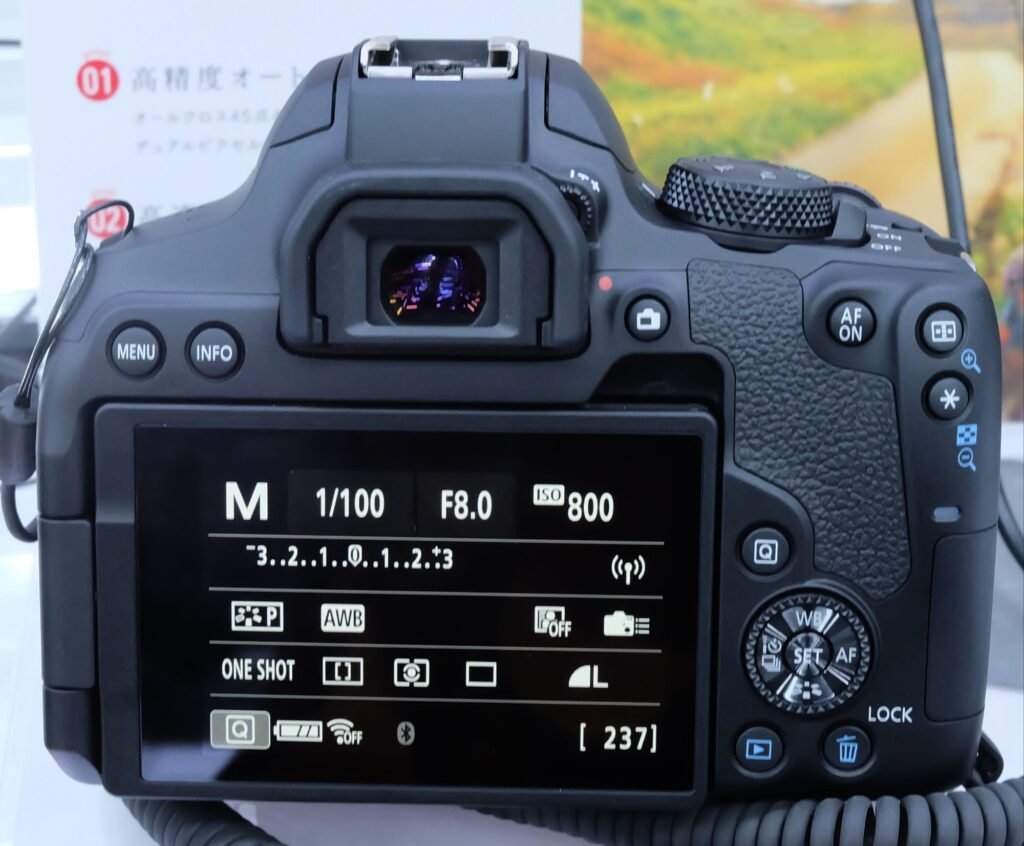
It combines a 24.1-megapixel APS-C CMOS sensor, DIGIC 8 processing, a 45-point all-cross-type optical viewfinder autofocus system, Dual Pixel CMOS AF, and a fully articulating touchscreen.
One of its most useful characteristics is that it can serve two different types of photographers. A beginner can start with automatic modes and gradually learn manual controls, while a more experienced user can take advantage of RAW shooting, interchangeable lenses, faster continuous shooting, and advanced autofocus options.
Canon EOS 850D at a Glance
Rather than being a professional action camera, the 850D is designed as an all-rounder.
It can comfortably handle everyday photography, family pictures, portraits, travel, landscapes, and casual wildlife work. It also provides 4K video, which gives it an advantage over several older Canon DSLRs.
Main Specifications
Feature Canon EOS 850D Type APS-C DSLR Sensor 24.1MP CMOS Sensor Size Approx. 22.3 × 14.9 mm Processor DIGIC 8 Standard ISO 100–25,600 Expanded ISO Up to 51,200 Viewfinder AF 45-point all-cross-type Continuous Shooting Up to 7 fps Live View AF Dual Pixel CMOS AF Video 4K UHD / Full HD Display 3.0-inch vari-angle touchscreen Viewfinder Optical Memory Card SD/SDHC/SDXC Wireless Wi-Fi/Bluetooth Lens Mount Canon EF/EF-S Battery LP-E17 Weight Approx. 515g with battery and card
Sensor and Image Detail
At the center of the 850D is a 24.1MP APS-C CMOS sensor.
For most photographers, this resolution is more than enough. It provides sufficient detail for social media, websites, photo books, normal prints, and moderate cropping.
The APS-C format also makes the camera smaller and lighter than Canon’s full-frame DSLR bodies.
The sensor’s 1.6x crop factor can be useful for photographers who want additional reach from telephoto lenses.
For example, a 250mm lens provides a field of view comparable to approximately 400mm on a full-frame camera.
DIGIC 8: The Processing Engine
Canon uses the DIGIC 8 processor inside the EOS 850D.
The processor handles image processing, autofocus operations, continuous shooting, noise reduction, and video-related functions.
It is also one of the reasons the 850D offers a more modern feature set than older Canon entry-level DSLRs.
How Good Is the Autofocus?
Autofocus performance depends on whether you are using the optical viewfinder or Live View.
Through the optical viewfinder, the camera provides 45 autofocus points, all of which are cross-type.
This is useful for everyday moving subjects and gives photographers more flexibility when composing with the viewfinder.
For Live View, Canon’s Dual Pixel CMOS AF provides sensor-based phase-detection autofocus.
This is particularly helpful for video and touchscreen-based shooting.
Continuous Shooting Performance
The EOS 850D can reach approximately 7 frames per second in continuous shooting under appropriate conditions.
That makes it capable of handling moderate action.
It can be useful for:
- Children playing
- Pets
- Casual sports
- Outdoor activities
- Birds
- Wildlife
- Events
However, photographers who specialize in very fast sports or birds in flight may want a more specialized camera with a faster burst rate and more advanced tracking.
4K Video Changes the Equation
One of the most important advantages of the EOS 850D over many older entry-level Canon DSLRs is its support for 4K UHD video.
For creators, this makes the camera more flexible than models limited to Full HD.
4K can be useful when producing:
- YouTube videos
- Travel videos
- Tutorials
- Interviews
- Product demonstrations
- Family videos
- Short films
The camera also supports Full HD recording at higher frame rates, making 1080p useful when smooth motion is more important than maximum resolution.
There are, however, limitations to its 4K implementation compared with newer mirrorless cameras, particularly regarding autofocus behavior and crop.
The Vari-Angle Screen Is a Major Advantage
The EOS 850D has a 3.0-inch vari-angle touchscreen LCD.
This is one of those features that may not look important on a specification sheet but becomes extremely useful during real photography.
The screen can be positioned for:
Low-angle compositions
You can place the camera close to the ground and still see the framing.
High-angle shots
The screen can be angled toward the photographer when the camera is held above head height.
Self-recording
The display can be turned toward the front for easier self-monitoring.
Video
Creators can frame themselves more conveniently when recording from a tripod.
Touchscreen Operation
The touchscreen makes the camera easier to operate, particularly for beginners.
Depending on the shooting mode, you can tap the display to select focus areas and navigate camera functions.
Photographers who are accustomed to smartphone controls may find the touchscreen more intuitive than relying entirely on physical buttons.
Optical Viewfinder
The traditional optical viewfinder gives the EOS 850D the classic DSLR shooting experience.
It can be particularly useful outdoors in strong sunlight because you are not relying solely on the rear LCD.
The optical viewfinder provides approximately 95% frame coverage.
This means the captured image includes a slightly larger area than what is visible through the viewfinder.
ISO and Low-Light Shooting
The camera’s standard ISO range is 100–25,600, with expansion up to ISO 51,200.
Lower ISO values generally provide the cleanest images.
When photographing indoors, at night, or in other low-light conditions, increasing ISO can help maintain a usable shutter speed.
However, higher ISO also introduces more noise.
One of the easiest ways to improve low-light photography is to pair the 850D with a faster lens.
A 50mm f/1.8-type lens, for example, can gather considerably more light than a basic kit zoom at its longest focal length.
Is It Good for Portraits?
Yes.
The EOS 850D is a capable portrait camera, especially when combined with a suitable prime lens.
The APS-C sensor and a wide-aperture lens can create noticeable background separation.
A 50mm lens is a popular inexpensive option, while an 85mm-type lens can provide a more traditional portrait perspective.
The camera’s 24.1MP resolution also provides plenty of detail for portrait editing and printing.
What About Wildlife?
The 850D can be used for wildlife photography, but it is best considered an enthusiast-level wildlife body rather than a specialist action camera.
Its 1.6x crop factor is useful with telephoto lenses, while the 7 fps burst mode can capture sequences of movement.
A 55–250mm-type lens is a practical starting point for beginners.
For serious bird photography, a longer and faster telephoto lens combined with a more advanced body may be preferable.
Travel Photography: One of Its Strong Areas
The EOS 850D is relatively light for a DSLR.
At approximately 515g with battery and card, the body is easier to carry than many larger enthusiast models.
Pairing it with a compact zoom creates a flexible travel setup.
You can use it for:
- Architecture
- Landscapes
- Street scenes
- Food photography
- Portraits
- Family photographs
- Wildlife
- Night scenes
Its articulating display is also helpful when photographing from unusual angles.
Everyday Family Photography
For family photography, the 850D provides a useful combination of autofocus, resolution, and automatic shooting modes.
Beginners can start with automatic exposure while learning how shutter speed, aperture, ISO, and focal length affect an image.
As skills improve, the camera provides enough manual control to continue developing.
This makes it more than just a beginner camera.
Lens Compatibility
The EOS 850D uses Canon’s EF/EF-S mount.
That gives users access to a large collection of Canon lenses.
Some practical combinations include: Photography Type Suitable Lens Category Everyday 18–55mm-type zoom Travel 18–135mm-type zoom Portrait 50mm / 85mm prime Wildlife 55–250mm / longer telephoto Landscape Wide-angle lens Macro Dedicated macro lens Low Light Fast-aperture prime
The body itself is only part of the system. Choosing the right lens for the intended subject can have a major impact on results.
Wireless Connectivity
The EOS 850D provides Wi-Fi and Bluetooth connectivity.
Wireless communication can be useful for transferring photographs to compatible smartphones and for remote camera operation.
This is particularly convenient for travel photographers who want to share photographs without removing the memory card.
Bluetooth can also help maintain a low-power connection between compatible devices.
Battery and Memory
The camera uses Canon’s LP-E17 rechargeable battery.
Battery life varies according to how the camera is used. Optical-viewfinder photography generally consumes less power than heavy Live View or video use.
The 850D uses a single SD memory-card slot supporting SD/SDHC/SDXC cards.
For normal photography this is sufficient, although professional photographers working on important assignments may prefer a body with dual-card redundancy.
Build and Handling
The 850D is designed as a relatively lightweight DSLR rather than a heavy professional body.
This makes it comfortable for beginners and travelers.
Its controls provide access to commonly used photographic settings without requiring users to navigate through every menu.
It is not built to the same rugged level as Canon’s professional sports-oriented DSLRs, so users working in harsh environments should take appropriate precautions.
Canon EOS 850D for YouTube
The 850D can be a useful camera for beginner and intermediate YouTube creators.
Its advantages include:
- 4K recording
- Full HD recording
- Vari-angle touchscreen
- Interchangeable lenses
- Dual Pixel CMOS AF
- External microphone support
- Wi-Fi/Bluetooth
The articulating screen is especially useful for creators who record themselves.
However, if video is your primary profession, newer mirrorless cameras may offer better autofocus, stabilization, rolling-shutter performance, and video codecs.
850D vs Nikon D5600
These two cameras are aimed at a similar audience. Feature Canon EOS 850D Nikon D5600 Resolution 24.1MP 24.2MP Processor DIGIC 8 EXPEED 4 Viewfinder AF 45 points 39 points Burst Up to 7 fps 5 fps Video 4K Full HD Screen Vari-angle touchscreen Vari-angle touchscreen Wireless Wi-Fi/Bluetooth Wi-Fi/Bluetooth Overall Generation Newer Older
The 850D has an advantage in burst speed, processor generation, and 4K video.
The D5600 remains attractive if found at a significantly lower price, particularly for still photography.
850D vs Canon EOS 90D
The EOS 90D is positioned higher than the 850D.
The 90D offers a higher-resolution 32.5MP APS-C sensor and stronger action-oriented performance, including up to approximately 10 fps continuous shooting.
The 850D is smaller and lighter and can be more approachable for beginners.
A photographer who values portability and affordability may prefer the 850D, while someone needing greater performance and resolution may prefer the 90D.
Things I Would Consider Before Buying
The EOS 850D is a relatively capable DSLR, but buying decisions should be based on what you actually need.
Choose it if you want:
- A lightweight DSLR
- Good still-image quality
- 4K video
- A fully articulating screen
- Beginner-friendly controls
- Canon EF/EF-S lens compatibility
- Decent action performance
Think about a newer camera if you need:
- Advanced animal and bird detection
- In-body stabilization
- High-end 4K video
- Very fast electronic shooting
- Professional-level tracking
- A compact mirrorless design
Used Camera Inspection Checklist
If you are buying an EOS 850D second-hand, spend a few minutes testing the camera before paying.
1. Take test photographs
Shoot at different ISO levels and check the files.
2. Test autofocus
Try both viewfinder AF and Live View AF.
3. Examine the screen
Check the touchscreen, hinge, brightness, and display for damage.
4. Test video
Record a short 4K and Full HD clip if possible.
5. Check the memory-card slot
Make sure photographs and videos are saved correctly.
6. Inspect the lens mount
A loose or damaged mount can create focusing or communication problems.
7. Check the battery
Older batteries may have reduced capacity.
8. Test wireless functions
If Wi-Fi and Bluetooth are important to you, test them before purchase.
Who Will Get the Most From the EOS 850D?
The camera is particularly suitable for someone who wants to move from a smartphone or basic compact camera into interchangeable-lens photography.
It can also work well for:
- Hobby photographers
- Students
- Travel enthusiasts
- Family photographers
- Portrait beginners
- Beginner YouTubers
- Casual wildlife photographers
- Photography learners
Its combination of automatic and manual features gives beginners room to grow.
The Main Reasons to Choose It
The EOS 850D is attractive because it avoids going too far in either direction.
It is not as basic as an entry-level camera, but it also isn’t as large or complicated as a professional DSLR.
Its 24.1MP sensor + 7 fps shooting + Dual Pixel CMOS AF + vari-angle touchscreen + 4K video create a fairly balanced package.
For someone who wants one camera to learn both photography and basic video, that balance is useful.
Where It Falls Behind Modern Cameras
Technology has moved forward since the 850D was introduced.
Modern mirrorless cameras can offer:
- Better subject recognition
- Faster electronic shooting
- Improved video autofocus
- In-body stabilization
- More sophisticated video features
- Smaller bodies
Therefore, the 850D makes the most sense when its DSLR design, lens ecosystem, or price is an advantage.
Final Recommendation
The Canon EOS 850D is a versatile APS-C DSLR aimed at photographers who want a lightweight body without giving up important enthusiast features.
Its 24.1MP sensor delivers plenty of resolution, while 45-point all-cross-type autofocus, approximately 7 fps continuous shooting, and Dual Pixel CMOS AF provide a solid foundation for both photography and video.
The fully articulating touchscreen and 4K recording are particularly useful features for creators.
It is not the best option for professional action photography or advanced video production, but for someone learning photography, traveling, taking portraits, photographing family and pets, or starting a YouTube channel, the 850D remains a well-rounded camera.
Final Rating
Category Rating Image Quality 4.4/5 Autofocus 4.3/5 Beginner Friendly 4.7/5 Portraits 4.5/5 Travel 4.7/5 Wildlife 4.0/5 Video 4.0/5 Portability 4.6/5 Lens Selection 4.6/5 Overall 4.4/5
Canon EOS 850D FAQs
1. Is Canon EOS 850D good for beginners?
Yes. Its automatic modes, touchscreen controls, optical viewfinder, and manual options make it suitable for beginners who want to learn photography.
2. How many megapixels does the EOS 850D have?
It has a 24.1-megapixel APS-C CMOS sensor.
3. Does Canon EOS 850D shoot 4K?
Yes. The EOS 850D supports 4K UHD video recording.
4. Is the EOS 850D full-frame?
No. It is an APS-C DSLR with Canon’s approximately 1.6x crop factor.
5. How fast can the Canon 850D shoot?
It can shoot at up to approximately 7 frames per second under suitable conditions.
6. Does the EOS 850D have a flip screen?
Yes. It has a fully articulating 3.0-inch touchscreen LCD.
7. Is Canon 850D good for portraits?
Yes. With a suitable fast prime lens, it can produce detailed portraits and attractive background separation.
8. Can the EOS 850D be used for wildlife?
Yes. Its APS-C sensor, 7 fps burst rate, autofocus system, and compatibility with telephoto lenses make it suitable for enthusiast wildlife photography.
9. Does Canon 850D have Wi-Fi?
Yes. It supports Wi-Fi and Bluetooth connectivity.
10. What lenses are compatible with the EOS 850D?
The camera supports Canon EF and EF-S lenses.
11. Is the Canon EOS 850D worth buying?
It can still be a useful choice for photography-focused users who want an affordable DSLR with 4K video and a fully articulating screen. If advanced mirrorless autofocus or professional video is required, newer cameras are worth considering.
Bottom Line
The Canon EOS 850D is best viewed as a balanced learning and enthusiast DSLR. It offers enough performance for serious photography while remaining approachable for beginners.
Its strongest combination is the 24.1MP APS-C sensor, 7 fps burst shooting, Dual Pixel CMOS AF, articulating touchscreen, and 4K video. For users who prefer Canon’s DSLR system and can find the camera at a sensible price, it remains a practical option.