Pentax K-1 Mark II Review: Full Specifications, Features, Performance, Pros and Cons
The Pentax K-1 Mark II is a professional full-frame DSLR camera designed for photographers who prioritize image quality, rugged construction, weather resistance, and outdoor photography performance.
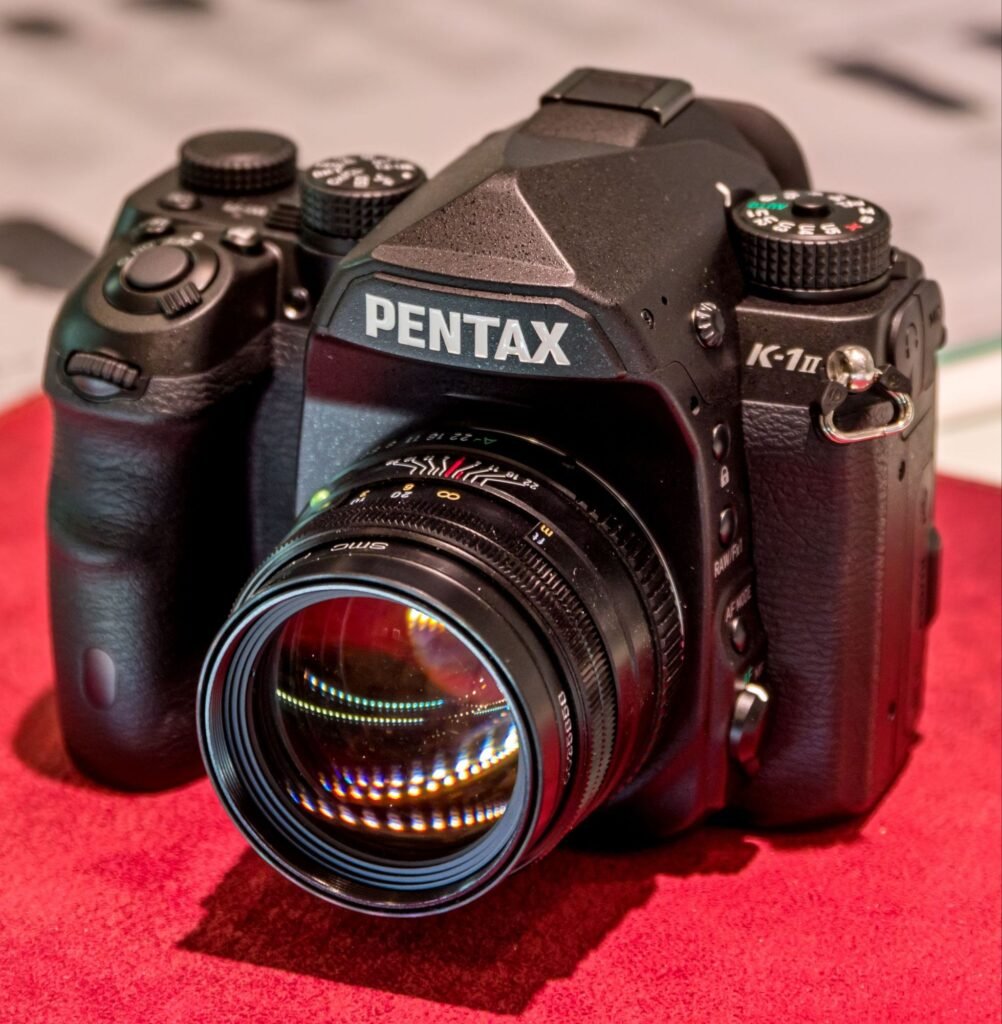
Developed by Ricoh Imaging, the Pentax K-1 Mark II combines a 36.4-megapixel full-frame sensor with advanced image processing, in-body image stabilization, a sophisticated autofocus system, and a durable weather-sealed body.
The camera is particularly attractive to landscape photographers, outdoor photographers, astrophotographers, wildlife enthusiasts, and serious photographers who prefer the traditional DSLR shooting experience.
One of the camera’s most important features is its five-axis in-body Shake Reduction system, which can help reduce the effects of camera shake when shooting handheld. This stabilization system also works with compatible lenses, making it useful for both still photography and specialized shooting techniques.
The K-1 Mark II is not designed to compete directly with the latest mirrorless cameras in terms of autofocus speed or video features. Instead, it focuses heavily on high-quality still photography, ruggedness, and outdoor usability.
Pentax K-1 Mark II Overview
The Pentax K-1 Mark II is a full-frame DSLR featuring a 36.4MP CMOS sensor.
Its high-resolution sensor provides enough detail for large prints, cropping, landscape photography, architecture, studio work, and many other applications.
Pentax has also designed the camera for demanding outdoor environments. Its weather-resistant construction and extensive sealing make it particularly appealing to photographers who regularly work in rain, snow, dust, and cold conditions.
Another distinctive feature is the camera’s illuminated body controls. Small LED lights around selected buttons and connection areas can make the camera easier to operate in low-light environments.
Pentax K-1 Mark II Key Specifications
Feature Pentax K-1 Mark II Camera Type Full-frame DSLR Sensor Full-frame CMOS Effective Resolution 36.4 MP Sensor Size Approximately 35.9 × 24.0 mm Processor PRIME IV Lens Mount Pentax K-mount Native ISO 100–819,200 Image Stabilization 5-axis in-body Shake Reduction Stabilization Up to approximately 5 stops Autofocus SAFOX 12 AF Points 33-point AF system Continuous Shooting Up to approximately 4.4 fps Maximum Shutter Speed 1/8000 sec Video Full HD Display 3.2-inch tilting LCD GPS Built-in Wi-Fi Built-in Memory Cards Dual SD slots Weather Sealing Yes Body Material Magnesium alloy Approx. Weight 1010 g with battery and card
Specifications can vary slightly depending on shooting mode, accessories, firmware, and measurement conditions.
36.4-Megapixel Full-Frame Sensor
One of the main attractions of the Pentax K-1 Mark II is its 36.4-megapixel full-frame CMOS sensor.
The sensor provides a high level of detail and gives photographers significant flexibility when cropping images.
This can be particularly valuable for landscape and architectural photography, where photographers often want to preserve fine details across a large frame.
The full-frame sensor also provides the classic full-frame perspective and can produce strong background separation when paired with fast-aperture lenses.
The 36.4MP resolution is suitable for:
- Landscape photography
- Architecture
- Portraits
- Studio photography
- Commercial photography
- Travel photography
- Wildlife photography
- Astrophotography
- Large-format printing
Pentax K-1 Mark II Image Quality
Image quality is one of the camera’s biggest strengths.
The high-resolution sensor can capture a large amount of detail, while the camera’s PRIME IV image processor helps process photographs efficiently.
The camera’s Pixel Shift Resolution System is another important feature.
Instead of capturing a single exposure, Pixel Shift can combine multiple images captured with tiny sensor movements to create a photograph with enhanced detail and color information under suitable conditions.
This mode is particularly useful when photographing stationary subjects from a tripod.
It can be valuable for:
- Still life
- Landscapes
- Architecture
- Product photography
- Artwork reproduction
Pixel Shift is less useful for moving subjects because multiple exposures are combined.
ISO Performance
The Pentax K-1 Mark II has an extremely broad ISO range, with sensitivity extending to ISO 819,200.
The extremely high ISO settings are primarily intended for situations where capturing an image is more important than maintaining maximum image quality.
For everyday photography, photographers will generally use much lower ISO settings.
The camera’s high-ISO capability can nevertheless be useful for:
- Night photography
- Wildlife
- Indoor photography
- Astrophotography
- Dark outdoor environments
The actual image quality at very high ISO settings depends on lighting, exposure, noise reduction, and other camera settings.
Pentax K-1 Mark II In-Body Image Stabilization
One of the most important features of the K-1 Mark II is its five-axis Shake Reduction system.
Unlike optical stabilization built into some lenses, the camera stabilizes the image sensor itself.
This means stabilization can work with many compatible lenses.
In-body stabilization can help photographers shoot at slower shutter speeds while reducing camera shake.
It can be useful for:
- Handheld landscapes
- Night photography
- Street photography
- Indoor photography
- Travel photography
- Low-light portraits
The effectiveness of stabilization depends on the subject, shutter speed, focal length, and shooting technique.
Pixel Shift Resolution System
Pentax’s Pixel Shift Resolution technology is a distinctive feature of the K-1 Mark II.
The system moves the sensor between multiple exposures and combines the captured information into a final image.
Under suitable conditions, this can provide improved detail and color accuracy compared with a conventional single exposure.
It works best when:
- The camera is mounted on a tripod.
- The subject is completely or mostly stationary.
- Wind and movement are minimal.
- The photographer can carefully control the composition.
It is not designed for fast-moving subjects.
For landscape photographers photographing completely stationary scenes, Pixel Shift can be a useful specialized tool.
Pentax K-1 Mark II Autofocus
The K-1 Mark II uses Pentax’s SAFOX 12 autofocus system.
The system provides 33 autofocus points, including cross-type points designed to improve focusing reliability under suitable conditions.
The autofocus system is capable of handling a range of photography styles, including:
- Portraits
- Landscapes
- Events
- Wildlife
- Travel
- General photography
However, compared with modern mirrorless cameras, the K-1 Mark II’s autofocus system is not as advanced in subject recognition and tracking.
Photographers who primarily shoot fast-moving sports or wildlife may therefore prefer a newer camera system.
Continuous Shooting Performance
The K-1 Mark II can shoot continuously at several frames per second depending on the selected shooting mode and image format.
Its performance is suitable for general action photography but is not its primary selling point.
The camera is better known for image quality, stabilization, ruggedness, and outdoor photography than for extremely fast burst shooting.
For sports photographers who need very high frame rates, a specialized sports camera would be more appropriate.
Pentax K-1 Mark II Weather Sealing
Weather resistance is one of the K-1 Mark II’s most impressive features.
The camera features extensive sealing designed to help protect it from dust and moisture.
This makes it especially attractive to outdoor photographers.
The camera can be used in environments such as:
- Rainy landscapes
- Snow
- Mountains
- Forests
- Beaches
- Desert environments
- Cold-weather locations
However, weather sealing does not mean the camera is completely waterproof.
Photographers should still use appropriate protection during heavy rain, storms, or prolonged exposure to water.
Build Quality
The K-1 Mark II uses a durable magnesium-alloy body designed for professional and outdoor use.
The rugged body provides a substantial and solid feel in the hand.
The camera is heavier than many modern mirrorless cameras, but that weight can also make it feel stable when used with larger lenses.
For photographers who regularly work outdoors, the build quality can be an important advantage.
Pentax K-1 Mark II Display
The camera features a 3.2-inch LCD monitor with a flexible tilting mechanism.
The screen can be adjusted for certain low-angle and high-angle shooting situations.
This can be useful for:
- Landscape photography
- Macro photography
- Low-angle compositions
- Tripod photography
The display is not designed like the fully articulating screens found on many newer cameras, but its unique mounting system provides useful flexibility.
Optical Viewfinder
The K-1 Mark II features a traditional optical viewfinder.
Many photographers prefer an optical viewfinder because it provides a direct view through the lens without electronic processing.
Advantages include:
- Natural real-time viewing
- Excellent visibility in bright outdoor conditions
- Low power consumption
- Traditional DSLR shooting experience
- No electronic display delay
For photographers who enjoy traditional DSLR cameras, this can be a major reason to choose the K-1 Mark II.
Built-in GPS
One of the unusual features of the Pentax K-1 Mark II is its built-in GPS functionality.
GPS can record location information with photographs, which can be useful for:
- Travel photography
- Landscape photography
- Hiking
- Outdoor exploration
- Geotagging photographs
The camera can also use GPS-related functionality for specialized astrophotography features.
AstroTracer
The K-1 Mark II includes Pentax’s AstroTracer functionality.
This feature combines GPS information, camera orientation data, and sensor movement to compensate for the apparent movement of stars caused by Earth’s rotation.
When used correctly, it can allow photographers to capture stars with reduced trailing during certain long-exposure astrophotography situations.
This makes the camera particularly interesting for astrophotographers.
AstroTracer works best when the camera has a clear view of the sky and is carefully positioned.
Pentax K-1 Mark II for Astrophotography
Astrophotography is one of the areas where the K-1 Mark II stands out.
Its full-frame sensor, high ISO capability, in-body stabilization, GPS, and AstroTracer system provide a useful combination for night-sky photography.
Photographers can use it to photograph:
- Milky Way landscapes
- Star fields
- Constellations
- Night landscapes
- Moonlit scenes
A wide-aperture wide-angle lens is generally recommended for serious astrophotography.
A sturdy tripod and careful focusing are also important.
Pentax K-1 Mark II for Landscape Photography
Landscape photography is arguably one of the camera’s strongest use cases.
The combination of:
- 36.4MP resolution
- Full-frame sensor
- In-body stabilization
- Pixel Shift Resolution
- Weather sealing
- GPS
- AstroTracer
makes the K-1 Mark II especially attractive to outdoor photographers.
The rugged construction is particularly useful when shooting in challenging environments.
Landscape photographers can also use the camera’s high resolution for large prints and detailed crops.
Pentax K-1 Mark II for Wildlife Photography
The K-1 Mark II can be used for wildlife photography, particularly when image quality and rugged construction are more important than extreme autofocus speed.
The 36.4MP sensor provides useful cropping flexibility.
The camera’s weather-resistant construction can also be valuable when photographing animals outdoors.
However, wildlife photographers who need advanced animal detection and extremely fast tracking may find modern mirrorless cameras more capable.
A high-quality telephoto lens is essential for serious wildlife work.
Pentax K-1 Mark II for Portrait Photography
The K-1 Mark II is capable of producing excellent portraits.
Its full-frame sensor allows photographers to use fast-aperture lenses to create attractive background blur.
Pentax offers several high-quality K-mount lenses suitable for portraits.
An 85mm-class lens can be a strong choice for traditional portraits, while a 70-200mm-class lens can provide additional flexibility.
Pentax K-1 Mark II for Travel Photography
The camera is capable of excellent travel photography, particularly for photographers who prioritize durability and image quality.
The built-in GPS can be especially useful for documenting travel locations.
However, the K-1 Mark II is relatively heavy.
Photographers who prioritize lightweight travel equipment may prefer a smaller mirrorless camera.
For those who don’t mind carrying a heavier body in exchange for ruggedness and full-frame image quality, the K-1 Mark II can be an excellent companion.
Pentax K-1 Mark II for Studio Photography
The camera’s 36.4MP sensor makes it suitable for studio work.
It can be used for:
- Portraits
- Product photography
- Fashion
- Commercial photography
- Still life
- Artwork reproduction
Pixel Shift Resolution can also be particularly useful in controlled studio environments when the subject remains completely stationary.
Video Capabilities
The Pentax K-1 Mark II is primarily a still photography camera.
It can record Full HD video, but video is not the camera’s main strength.
Compared with newer mirrorless cameras, it lacks many modern video features such as advanced 4K recording, sophisticated subject tracking, and newer professional video formats.
Therefore, photographers who primarily create video content should consider other camera options.
For still photography with occasional video recording, however, its Full HD capability can be sufficient.
Dual SD Card Slots
The K-1 Mark II includes dual SD card slots.
This is particularly useful for professional photographers.
Two cards can provide additional flexibility for:
- Backup recording
- Overflow storage
- Separating file types
For wedding and event photographers, having multiple storage options can help manage large amounts of photographs.
Professional users should still maintain regular backups.
Wi-Fi Connectivity
The K-1 Mark II includes built-in Wi-Fi connectivity.
Wireless functionality can be used for compatible remote control and image transfer applications.
This can be useful when photographers want to:
- Transfer photographs
- Control the camera remotely
- Share images
- Review photographs on compatible devices
Pentax K-Mount Lens Compatibility
The K-1 Mark II uses the Pentax K-mount.
Pentax has a long history of K-mount lenses, including both modern and older optics.
Photographers can choose lenses for:
- Landscapes
- Portraits
- Wildlife
- Macro
- Architecture
- Street photography
- Travel
- Sports
The large history of the K-mount system is one of the major advantages of choosing Pentax.
Pentax K-1 Mark II Pros and Cons
Pros
- 36.4MP full-frame sensor
- Excellent image quality
- Strong dynamic range
- Five-axis in-body image stabilization
- Pixel Shift Resolution
- Extremely broad ISO range
- Rugged magnesium-alloy construction
- Extensive weather sealing
- Built-in GPS
- AstroTracer functionality
- Dual SD card slots
- Wi-Fi connectivity
- Large optical viewfinder
- Excellent landscape photography capabilities
- Very good astrophotography features
- Excellent outdoor durability
- Compatible with a large range of K-mount lenses
Cons
- Heavy compared with many modern mirrorless cameras
- Autofocus is not as advanced as newer mirrorless systems
- Slow compared with dedicated sports cameras
- Video capabilities are limited
- No 4K video
- K-mount system has a smaller modern ecosystem than some competing mounts
- Large body may not be ideal for casual travel
- Pixel Shift is mainly useful for stationary subjects
Pentax K-1 Mark II vs Nikon D850
The Pentax K-1 Mark II and Nikon D850 are both high-resolution full-frame DSLRs, but their strengths are different.
The Nikon D850 has a higher-resolution 45.7MP sensor and a more advanced autofocus system.
The Pentax K-1 Mark II has a 36.4MP sensor but offers features such as five-axis in-body stabilization, built-in GPS, and AstroTracer.
For commercial and high-resolution studio work, the D850 may have an advantage.
For outdoor landscape and astrophotography, the K-1 Mark II has several unique features that make it particularly attractive.
Pentax K-1 Mark II vs Canon EOS 5D Mark IV
The Canon EOS 5D Mark IV has a 30.4MP full-frame sensor, while the K-1 Mark II offers 36.4MP.
Pentax provides built-in sensor stabilization and GPS, while the Canon offers a broader ecosystem of Canon EF lenses and strong professional event photography capabilities.
The 5D Mark IV is particularly attractive for wedding and event photographers.
The K-1 Mark II is especially interesting for photographers who prioritize outdoor photography, landscape work, astrophotography, and rugged weather-resistant equipment.
Pentax K-1 Mark II vs Nikon D780
The Nikon D780 uses a 24.5MP sensor and provides more modern Live View autofocus and 4K video.
The Pentax K-1 Mark II offers higher resolution, in-body stabilization, built-in GPS, and specialized astrophotography features.
The D780 may be more suitable for photographers who want a versatile DSLR with stronger video and Live View capabilities.
The K-1 Mark II may be more appealing to still photographers who prioritize stabilization, ruggedness, landscape photography, and AstroTracer.
Is Pentax K-1 Mark II Still Worth Buying?
The K-1 Mark II can still be an attractive camera for the right photographer.
It is not a camera designed to compete with the latest mirrorless models in every category.
Instead, it offers a distinctive combination of features that many photographers still appreciate.
Its strongest areas include:
- Landscape photography
- Astrophotography
- Outdoor photography
- Travel photography
- High-resolution still photography
- Long-exposure photography
- Challenging weather conditions
If your priority is advanced autofocus, professional video, or a lightweight body, a newer mirrorless camera may be a better choice.
But if you want a rugged full-frame DSLR with built-in stabilization, GPS, and AstroTracer, the K-1 Mark II remains a unique option.
Who Should Buy the Pentax K-1 Mark II?
The camera is particularly suitable for:
Landscape Photographers
Its high resolution, stabilization, weather sealing, and Pixel Shift system make it an excellent landscape tool.
Astrophotographers
The built-in GPS and AstroTracer system make it especially interesting for photographing the night sky.
Outdoor Photographers
The rugged weather-resistant construction is useful in challenging environments.
Travel Photographers
GPS and durability can be valuable for outdoor travel.
Serious DSLR Enthusiasts
Photographers who prefer optical viewfinders and traditional DSLR handling may appreciate the K-1 Mark II.
Pentax Lens Owners
Photographers who already own K-mount lenses can take advantage of their existing equipment.
Who Should Avoid the Pentax K-1 Mark II?
The K-1 Mark II may not be ideal if you need:
- Advanced animal autofocus
- Very fast burst shooting
- Professional 4K video
- Lightweight equipment
- The newest mirrorless autofocus technology
- A large modern lens ecosystem
For those requirements, a modern mirrorless system may be a better option.
Recommended Lenses for Pentax K-1 Mark II
The best lens depends on the type of photography.
For landscapes, a wide-angle zoom is an excellent choice.
For portraits, an 85mm-class prime lens can provide attractive background separation.
For wildlife, a 150-450mm-class telephoto lens can provide useful reach.
For general travel photography, a 24-70mm-class zoom offers versatility.
For macro photography, a dedicated 100mm-class macro lens can provide excellent close-up detail.
For astrophotography, a fast wide-angle lens with a large maximum aperture is recommended.
Pentax K-1 Mark II Price
The actual price of the Pentax K-1 Mark II can vary significantly depending on region, availability, seller, lens bundle, and whether the camera is new or used.
Because the camera is aimed at a specialized DSLR audience, availability may be more limited than that of mainstream Canon and Nikon models.
When purchasing a used K-1 Mark II, inspect:
- Sensor condition
- Shutter count
- LCD screen
- Viewfinder
- Autofocus
- Image stabilization
- GPS functionality
- Memory card slots
- Battery condition
- Weather-sealing condition
- Lens mount
- USB and HDMI ports
- Signs of moisture or physical damage
It is also important to test the camera with a compatible lens before completing a used purchase.
Pentax K-1 Mark II Final Verdict
The Pentax K-1 Mark II is a distinctive full-frame DSLR built primarily for serious still photography and outdoor use.
Its 36.4MP sensor provides excellent resolution, while five-axis in-body stabilization helps photographers shoot handheld in challenging conditions.
The camera becomes even more interesting for landscape and astrophotography because of features such as Pixel Shift Resolution, built-in GPS, and AstroTracer.
Its rugged weather-resistant construction is another major advantage for photographers who regularly work outdoors.
However, the K-1 Mark II is not the best choice for everyone.
Its large and heavy body, older autofocus technology, and limited video capabilities make it less competitive with modern mirrorless cameras.
For photographers who value traditional DSLR handling, excellent still-image quality, rugged construction, and unique astrophotography features, however, the Pentax K-1 Mark II remains an impressive and specialized camera.
Pentax K-1 Mark II Rating
Category Rating Image Quality 9/10 Resolution 9/10 Autofocus 7.5/10 Image Stabilization 9.5/10 Build Quality 9.5/10 Weather Resistance 9.5/10 Landscape Photography 9.5/10 Astrophotography 9.5/10 Portrait Photography 8.5/10 Wildlife Photography 8/10 Video 6.5/10 Travel Photography 7.5/10 Professional Still Photography 9/10 Overall 8.8/10
Frequently Asked Questions
Is Pentax K-1 Mark II a full-frame camera?
Yes. The Pentax K-1 Mark II uses a full-frame CMOS sensor.
How many megapixels does the Pentax K-1 Mark II have?
The camera has approximately 36.4 megapixels of effective resolution.
Does Pentax K-1 Mark II have image stabilization?
Yes. It features a five-axis in-body Shake Reduction system.
Is Pentax K-1 Mark II good for landscape photography?
Yes. Landscape photography is one of its strongest applications because of its high-resolution sensor, stabilization, weather resistance, and Pixel Shift functionality.
Is Pentax K-1 Mark II good for astrophotography?
Yes. Its built-in GPS and AstroTracer feature make it particularly interesting for astrophotography.
Does Pentax K-1 Mark II have GPS?
Yes. GPS functionality is built into the camera.
Does Pentax K-1 Mark II record 4K video?
No. The camera is primarily a still-photography DSLR and does not provide 4K video recording.
What lens mount does Pentax K-1 Mark II use?
It uses the Pentax K-mount.
Is Pentax K-1 Mark II weather sealed?
Yes. The camera features extensive weather-resistant sealing designed for outdoor use.
Is Pentax K-1 Mark II good for wildlife photography?
Yes, it can produce excellent wildlife photographs, particularly because of its high-resolution sensor and rugged body. However, photographers who need the latest animal-detection autofocus and very high burst rates may prefer a newer mirrorless camera.
Is Pentax K-1 Mark II good for beginners?
It can be used by beginners, but its professional controls and relatively specialized features make it better suited to serious enthusiasts and experienced photographers.
Is Pentax K-1 Mark II still worth buying?
For photographers who want a rugged full-frame DSLR with in-body stabilization, GPS, AstroTracer, and excellent still-image quality, it can still be a worthwhile choice. For advanced video or the newest autofocus technology, newer mirrorless cameras are generally more suitable.
What type of photographer is Pentax K-1 Mark II best for?
It is particularly well suited to landscape photographers, astrophotographers, outdoor photographers, travel photographers, serious DSLR enthusiasts, and photographers who already own Pentax K-mount lenses.