Canon EOS 250D / Rebel SL3 Review: A Compact DSLR for Beginners
The Canon EOS 250D, also known as the Canon Rebel SL3 in the United States, is a compact entry-level DSLR designed for photographers who want the flexibility of interchangeable lenses without carrying a large camera body.
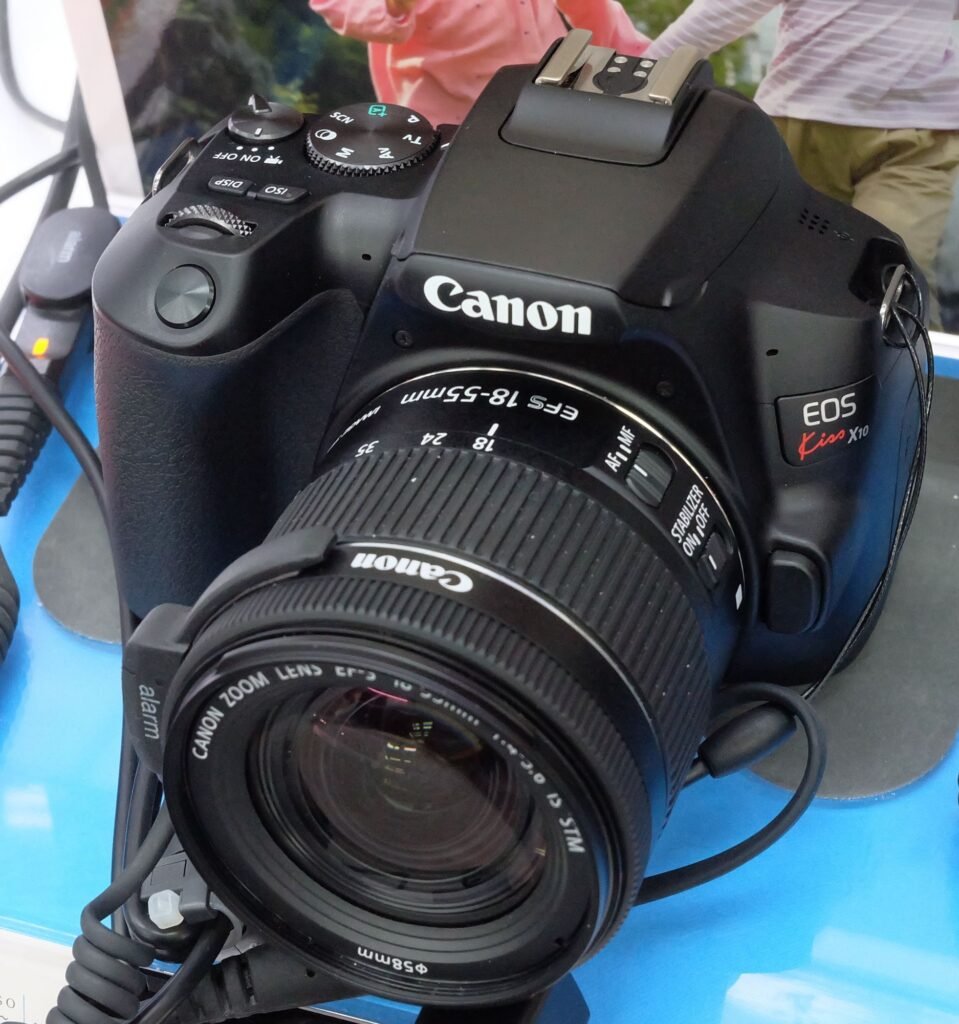
It combines a 24.1-megapixel APS-C CMOS sensor, DIGIC 8 image processor, Dual Pixel CMOS autofocus, a fully articulating touchscreen and 4K video recording. Its relatively small body also makes it an appealing option for travel, family photography and beginners moving up from a smartphone.
Quick Look at the Canon EOS 250D
Specification Canon EOS 250D / Rebel SL3 Camera Type DSLR Sensor APS-C CMOS Effective Resolution 24.1 MP Processor DIGIC 8 ISO Range 100–25,600 Expanded ISO Up to 51,200 Viewfinder AF 9-point AF Live View AF Dual Pixel CMOS AF Continuous Shooting Up to 5 fps Maximum Shutter Speed 1/4000 sec Video 4K UHD + Full HD LCD 3-inch Vari-angle Touchscreen Viewfinder Optical Storage SD/SDHC/SDXC Lens Mount Canon EF/EF-S Battery LP-E17 Weight Approx. 449g with battery and card
Specifications can vary slightly by market and shooting conditions.
The Main Reason to Consider the EOS 250D
The EOS 250D’s biggest attraction is its combination of small size and DSLR functionality.
Many beginners want:
- A proper camera sensor
- Interchangeable lenses
- Manual controls
- An optical viewfinder
- Good still-image quality
- Easy smartphone connectivity
- A screen that can face forward
The 250D attempts to provide all of these in a relatively compact body.
This makes it especially interesting for people who find larger DSLRs uncomfortable to carry.
24.1MP APS-C Sensor
At the center of the camera is a 24.1MP APS-C CMOS sensor.
For everyday photography, this provides enough resolution for:
- Portraits
- Landscapes
- Family photographs
- Travel images
- Food photography
- Product photography
- Street photography
- Social media content
The APS-C format is also smaller than a full-frame sensor, which allows Canon to keep the overall camera body relatively compact.
What Does APS-C Mean for a Beginner?
APS-C refers to the physical size of the camera’s image sensor.
The EOS 250D’s APS-C sensor gives photographers considerably more creative control than a basic compact camera, especially when combined with different lenses.
For example, a wide-angle lens can be used for landscapes, while a longer lens can be used for portraits or distant subjects.
The camera’s 1.6× crop factor also gives telephoto lenses a useful effective field-of-view advantage for subjects such as wildlife and sports.
DIGIC 8 Processing
Canon uses its DIGIC 8 image processor in the EOS 250D.
The processor contributes to several important camera functions, including:
- Image processing
- Autofocus performance
- Continuous shooting
- Noise reduction
- Video processing
- Camera responsiveness
For an entry-level DSLR, DIGIC 8 gives the 250D a fairly modern processing platform compared with many older beginner cameras.
ISO: Useful Range for Everyday Shooting
The standard ISO range is 100–25,600, with expansion available up to ISO 51,200.
A simple approach is: Situation Suggested Starting ISO Bright sunlight 100 Outdoor shade 200–400 Cloudy conditions 400–800 Indoor photography 800–1600 Darker environments 1600+
These are starting points rather than fixed rules.
In low light, increasing ISO can help maintain a usable shutter speed, although higher ISO settings generally introduce more visible noise.
Autofocus Has Two Different Personalities
One interesting aspect of the EOS 250D is that its autofocus experience changes depending on how you use the camera.
Through the Optical Viewfinder
The camera uses a 9-point autofocus system when shooting through the optical viewfinder.
This is relatively basic by modern standards.
Using Live View
Switch to Live View and the camera uses Dual Pixel CMOS AF, which provides a much more flexible focusing experience.
This is particularly useful when:
- Shooting from unusual angles
- Recording video
- Using the touchscreen
- Photographing people
- Composing using the LCD
This difference is important when deciding whether the 250D suits your shooting style.
The Fully Articulating Touchscreen
For many beginners, the screen may actually be one of the most useful features.
The 3-inch LCD can be rotated and positioned for different shooting angles.
This makes it useful for:
Low-angle photography
You don’t always need to get down on the ground to compose a shot.
High-angle photography
Useful when shooting over crowds or objects.
Self-recording
The screen can face toward the user.
Travel photography
You can compose from unusual positions more comfortably.
The touchscreen also makes navigating menus and selecting focus points more intuitive.
4K Video: A Major Advantage
Unlike the Nikon D3500, the Canon EOS 250D supports 4K video recording.
It can record 4K UHD footage, as well as Full HD and HD video at various frame rates.
For beginners interested in YouTube, travel videos or family content, this gives the 250D an important advantage over many older entry-level DSLRs.
However, 4K mode has some limitations compared with Canon’s more advanced cameras, particularly in autofocus and field-of-view behavior.
So the presence of “4K” should not automatically be interpreted as professional-level video capability.
Is It a Good YouTube Camera?
It can be a useful starter camera for YouTube.
The combination of:
- Fully articulating screen
- Dual Pixel CMOS AF
- 4K recording
- External microphone support
- Interchangeable lenses
- Compact body
makes it suitable for beginner video creators.
For a simple talking-head setup, an affordable lens, microphone and decent lighting can make a bigger difference to the final result than simply buying a more expensive camera body.
Continuous Shooting
The EOS 250D can shoot at approximately 5 frames per second in continuous shooting.
This is enough for casual action such as:
- Children playing
- Pets
- Casual sports
- Street scenes
- Family events
However, photographers who regularly shoot fast-moving wildlife or professional sports will probably want a camera with a faster burst rate and more advanced autofocus.
Shutter Speed
The maximum shutter speed is 1/4000 second.
This is useful for freezing reasonably fast subjects and controlling exposure when shooting with wider apertures in bright conditions.
For example, on a sunny day, a fast shutter speed can help you use a wider aperture for a shallow-depth-of-field portrait.
Portrait Photography
The EOS 250D can be an excellent learning platform for portrait photography.
The camera body is only part of the equation. The lens you choose can dramatically change the result.
A fast prime lens can provide:
- More background blur
- Better low-light performance
- Stronger subject separation
- A different visual perspective
For beginners, learning how distance, focal length and aperture affect background blur is often more valuable than simply increasing megapixels.
Landscape Photography
The 24.1MP APS-C sensor provides plenty of resolution for landscapes.
With a wide-angle EF-S lens, the camera can be used for:
- Mountains
- Architecture
- Beaches
- Cityscapes
- Nature
- Travel scenes
Using a tripod and lower ISO can also help maximize image quality in static scenes.
Travel Photography: Probably Its Best Match
The compact DSLR body is one of the EOS 250D’s strongest characteristics.
At approximately 449g with battery and memory card, it is relatively lightweight for a DSLR.
A basic 18–55mm lens can cover a large portion of normal travel photography:
Wide end: buildings, landscapes and interiors
Middle range: streets and everyday scenes
Long end: portraits and distant details
This makes the camera-and-kit-lens combination practical for travelers who want more control than a phone without carrying a professional-sized camera.
Wildlife Photography: Capable, But Know the Limits
The APS-C sensor and 1.6× crop factor can be helpful when using telephoto lenses.
For example, a 300mm lens provides a field of view comparable to approximately 480mm on a full-frame camera.
That can be useful for distant animals.
However, the 250D’s relatively simple viewfinder autofocus and 5 fps shooting mean it isn’t designed as a dedicated wildlife/action body.
For serious bird photography, a higher-end DSLR or modern mirrorless camera is a better choice.
Battery and Storage
The EOS 250D uses the LP-E17 rechargeable lithium-ion battery and records images to SD-family memory cards.
For normal photography, carrying a spare battery is still a good idea, especially when traveling or shooting heavily with Live View.
A fast, reliable SD card is also recommended for continuous shooting and video recording.
Canon EF and EF-S Lens Ecosystem
One of the biggest benefits of choosing the EOS 250D is access to Canon’s extensive EF and EF-S lens ecosystem.
A beginner can start with a kit zoom and later add specialized lenses.
Good lens categories to explore
18–55mm
General-purpose starter lens.
50mm prime
Popular for portraits and low-light photography.
10–18mm wide-angle
Useful for landscapes, architecture and interiors.
55–250mm
Useful for wildlife, sports and distant subjects.
This upgrade path lets you improve your photography without immediately replacing the camera body.
Connectivity
The EOS 250D includes Wi-Fi and Bluetooth connectivity, allowing compatible mobile devices to connect with the camera.
This is useful for:
- Transferring photographs
- Remote shooting
- Sharing images
- Smartphone-based camera control
For photographers who frequently post their work online, wireless connectivity can save time compared with transferring every image through a computer.
What the EOS 250D Does Better Than the Nikon D3500
The two cameras are both beginner-oriented DSLRs, but their feature sets are different. Feature Canon EOS 250D Nikon D3500 Resolution 24.1MP 24.2MP Sensor APS-C DX APS-C Processor DIGIC 8 EXPEED 4 Max Burst Approx. 5 fps Approx. 5 fps Video 4K Full HD Screen Vari-angle touchscreen Fixed LCD Live View AF Dual Pixel CMOS AF Contrast-detect AF Viewfinder AF 9 points 11 points Connectivity Wi-Fi/Bluetooth Bluetooth/SnapBridge Weight Approx. 449g Approx. 365g
The Nikon is lighter, while the Canon provides a more feature-rich Live View and video experience.
EOS 250D vs Canon EOS 850D
The EOS 850D is positioned above the 250D.
The 850D offers a more advanced autofocus system, faster continuous shooting and a more substantial feature set.
The 250D, meanwhile, has a major advantage for people who prioritize compactness and simplicity.
Choose the 250D when portability matters more.
Choose the 850D when you need stronger autofocus and more advanced shooting capabilities.
Things You Should Know Before Buying
The EOS 250D is not a professional DSLR.
Its strengths are different.
You should consider it if:
- You are new to photography
- You want an optical viewfinder
- You want interchangeable lenses
- You want a lightweight DSLR
- You want a flip/vari-angle screen
- You want 4K recording
- You want to learn manual photography
- You already own compatible Canon EF/EF-S lenses
Think about another camera if:
- You need professional-level autofocus
- You shoot fast sports regularly
- You need high-speed burst shooting
- You want advanced 4K video
- You want modern subject-recognition autofocus
- You prefer a compact mirrorless system
Strengths and Weaknesses
What I Like
Compact body
Easy to carry compared with many traditional DSLRs.
24.1MP sensor
More than enough resolution for everyday photography.
Fully articulating touchscreen
Very useful for video and creative angles.
Dual Pixel CMOS AF
A strong feature when shooting through Live View.
4K video
Adds flexibility for beginner content creators.
Interchangeable lenses
The camera can evolve with your photography skills.
Optical viewfinder
Provides a traditional DSLR shooting experience.
What Could Be Better
Viewfinder autofocus is basic
Only 9 AF points are available through the optical viewfinder.
5 fps burst
Adequate for casual action but not ideal for serious sports.
Older DSLR platform
Modern mirrorless cameras offer more advanced features.
4K limitations
Its 4K implementation isn’t equivalent to higher-end Canon models.
Final Recommendation
The Canon EOS 250D / Rebel SL3 is best understood as a small DSLR with an unusually useful feature set for beginners.
Its 24.1MP APS-C sensor delivers enough resolution for serious learning, while Dual Pixel CMOS AF, the fully articulating touchscreen and 4K recording make it more versatile than many older entry-level DSLRs.
Its biggest advantage is the balance between size, simplicity and creative control.
If your priority is still photography, travel and learning the fundamentals, the 250D can be a very capable starting point.
If video, fast action or advanced autofocus are your main priorities, newer mirrorless cameras are likely to be a better long-term investment.
Overall Score
Canon EOS 250D / Rebel SL3 — 8.5/10 for beginners
Best suited for: Beginner photography, travel, portraits, family photography, content creation and everyday shooting.
Not the best choice for: Professional sports, advanced wildlife photography and professional-level video production.
Frequently Asked Questions
Is Canon EOS 250D good for beginners?
Yes. Its automatic modes, touchscreen controls, compact design and interchangeable-lens system make it a practical learning camera for beginners.
Does Canon EOS 250D have 4K?
Yes. The EOS 250D supports 4K UHD video recording, although its 4K mode has limitations compared with higher-end Canon cameras.
Is Canon 250D good for YouTube?
Yes. Its articulating screen, Live View autofocus, 4K recording and external microphone support make it suitable for beginner YouTube and video projects.
Is Canon 250D better than Nikon D3500?
It depends on your priorities. The Nikon D3500 is lighter and has excellent battery endurance, while the Canon 250D offers 4K, a fully articulating touchscreen and stronger Live View autofocus functionality.
Can Canon 250D use different lenses?
Yes. The camera uses Canon’s EF/EF-S lens mount, giving photographers access to a wide range of compatible lenses.
Is Canon EOS 250D still worth buying?
It can be worth considering if you find one in good condition at an attractive price. However, buyers should compare its price with newer mirrorless cameras before making a decision.