Nikon D3500 Review: A Beginner-Friendly DSLR for Photography and Travel
The Nikon D3500 is one of Nikon’s most approachable DSLR cameras for people who want to move beyond smartphone photography without dealing with complicated controls. It combines a 24.2-megapixel DX-format sensor, simple controls, a lightweight body, 5 fps continuous shooting and Full HD video in a compact DSLR design.
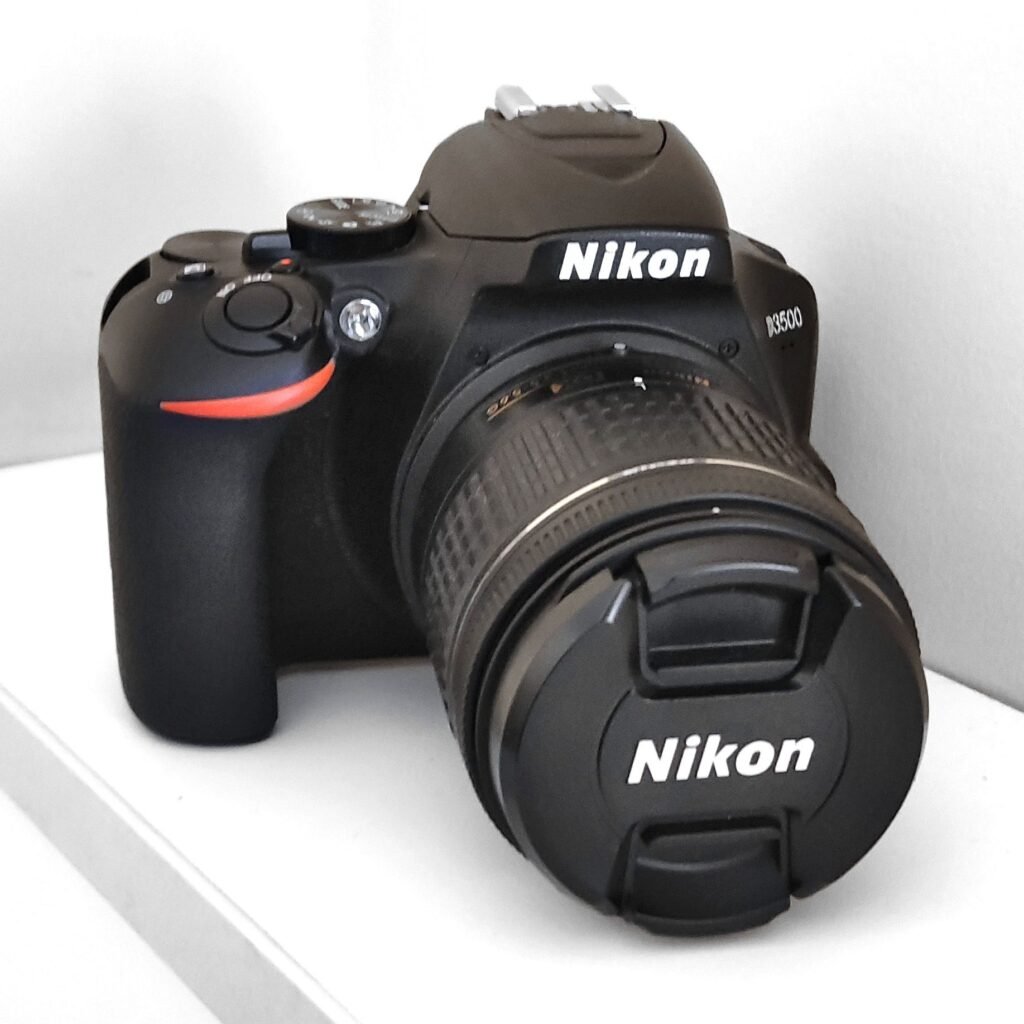
Although it is an older entry-level DSLR, the D3500 can still be an interesting option for beginners, students, travelers and photography enthusiasts who want to learn interchangeable-lens photography at a relatively low cost.
Nikon D3500 at a Glance
Feature Nikon D3500 Camera Type DSLR Sensor DX-format CMOS Resolution 24.2 MP Sensor Size 23.5 × 15.6 mm Processor EXPEED image-processing system ISO Range 100–25,600 Autofocus 11-point AF Continuous Shooting Up to 5 fps Maximum Shutter Speed 1/4000 sec Video Full HD 1080p up to 60p Viewfinder Optical pentamirror LCD 3-inch TFT-LCD Storage SD/SDHC/SDXC Lens Mount Nikon F Battery EN-EL14a Body Weight Approx. 365g
Specifications are based on Nikon’s official product information.
Why Was the D3500 Made for Beginners?
Nikon designed the D3500 around simplicity rather than professional-level complexity. Its Guide Mode can provide on-screen assistance, while Auto mode allows beginners to start taking photographs without understanding every manual camera setting.
This makes the camera particularly suitable for someone buying their first DSLR.
Instead of immediately learning aperture, shutter speed, ISO and autofocus settings separately, a new photographer can begin with automatic modes and gradually move toward manual control.
Image Quality: Where the D3500 Still Performs Well
The D3500 uses a 24.2MP DX-format CMOS sensor measuring approximately 23.5 × 15.6 mm. It can record large images at 6000 × 4000 pixels and also supports Nikon’s NEF RAW format for photographers who want more flexibility while editing.
For everyday photography, this resolution is more than enough for:
- Family photographs
- Travel photography
- Portraits
- Landscapes
- Food photography
- Product photographs
- Social media images
- Basic event photography
The relatively large DSLR sensor also gives photographers considerably more control over depth of field than a typical smartphone camera.
A Simple Way to Understand Its 24.2MP Sensor
Megapixels alone don’t determine whether a camera produces a good photograph.
The D3500’s combination of a 24.2MP sensor and interchangeable lenses gives beginners room to improve their photography skills.
For example:
With an 18–55mm lens:
- 18mm is useful for landscapes and interiors.
- Around 35mm works well for everyday photography.
- 55mm can be useful for portraits.
With a telephoto lens, the camera can also become useful for wildlife, sports and distant subjects.
ISO Performance
The Nikon D3500 offers a standard ISO range of 100 to 25,600.
ISO 100 is useful in bright outdoor conditions, while higher ISO settings can help when shooting in darker environments.
A practical approach for beginners is:
- ISO 100–200: Bright daylight
- ISO 400–800: Indoor or cloudy conditions
- ISO 1600: Dim indoor environments
- ISO 3200+: Darker situations when maintaining shutter speed is important
Higher ISO settings can introduce more image noise, so photographers should generally use the lowest practical ISO.
Autofocus: Simple but Limited
The D3500 uses an 11-point autofocus system, including 3D tracking capabilities.
For everyday subjects, portraits, landscapes and family photography, this system is straightforward to use.
However, modern mirrorless cameras and higher-end DSLRs offer much more sophisticated autofocus systems.
The D3500 works well for:
- Children
- Pets
- Casual action
- Portraits
- Travel
- Everyday photography
It is less ideal for:
- Professional sports
- Fast wildlife
- Birds in flight
- Complex moving subjects
If fast action photography is your primary goal, a camera such as the Nikon D500 is considerably more specialized.
5 FPS Continuous Shooting
The D3500 can shoot at up to 5 frames per second under specified shooting conditions.
That gives beginners the ability to capture several frames during a short action sequence.
For example, you can use continuous shooting when photographing:
- A child running
- A pet jumping
- A cyclist passing by
- A casual sports event
- A candid moment
It isn’t designed to compete with professional high-speed cameras, but 5 fps is useful for an entry-level DSLR.
What About Video?
The D3500 records Full HD 1920 × 1080 video up to 60 fps. It also supports other Full HD frame rates including 50p, 30p, 25p and 24p.
This makes it suitable for:
- YouTube beginners
- Family videos
- Travel videos
- Basic tutorials
- Social media clips
- Personal memories
However, there is no 4K recording.
Therefore, if video is your main reason for buying a camera, a newer mirrorless camera would generally make more sense.
The Optical Viewfinder Advantage
Unlike a smartphone, the D3500 provides an optical DSLR viewfinder.
The viewfinder offers approximately 95% frame coverage and approximately 0.85× magnification.
This can be particularly useful in bright sunlight, where viewing a smartphone or LCD screen can sometimes be difficult.
For traditional photography, composing through the optical viewfinder also gives the camera a more classic DSLR shooting experience.
The 3-Inch LCD Screen
The camera has a 3-inch TFT-LCD monitor.
One limitation is that the screen is not a fully articulating touchscreen.
This means photographers who regularly shoot themselves, vlogs or unusual low/high angles may find newer cameras more convenient.
For normal photography, however, the display is perfectly functional.
Travel Photography: One of Its Strongest Areas
The D3500’s compact body is one of its biggest advantages.
Nikon lists the body weight at approximately 365g, making it relatively light for a DSLR.
That makes it attractive for:
Travel + 18–55mm lens
This combination can cover:
- Streets
- Buildings
- Landscapes
- Food
- People
- Family photographs
- General sightseeing
For travelers who don’t want a heavy professional camera, the D3500 can be a practical choice.
Battery Life Is Surprisingly Strong
One of the D3500’s standout specifications is battery endurance.
Nikon’s launch information rated the camera for approximately 1,550 shots per charge under its specified testing conditions.
Actual battery life will vary depending on Live View use, temperature, flash, image review and other settings.
Nevertheless, this is an important advantage for travelers who don’t want to constantly recharge their camera.
Smartphone Connectivity
The D3500 supports Nikon’s SnapBridge system for compatible smartphones and tablets. Nikon describes SnapBridge as a way to transfer/share images and remotely trigger the camera using a compatible mobile device.
This is useful when you want to:
- Take photographs with the DSLR.
- Transfer selected images to your phone.
- Share them online.
It gives the traditional DSLR a more convenient connection to modern smartphone workflows.
Lens Compatibility
The D3500 uses Nikon’s F bayonet mount. Autofocus is available with compatible AF-P and Type E/G AF-S lenses.
This means beginners can start with a standard zoom and later expand their system.
Useful lens categories
18–55mm zoom
Best starting point for general photography.
35mm or 50mm prime
Useful for portraits, low-light photography and learning composition.
55–200mm / 70–300mm telephoto
Useful for wildlife, sports and distant subjects.
Macro lens
Useful for flowers, insects and detailed close-ups.
One of the main advantages of an interchangeable-lens DSLR is that the camera can grow with the photographer.
What Can You Photograph With the D3500?
Portrait Photography
The 24.2MP sensor provides plenty of resolution for portraits. Pairing the camera with a fast prime lens can also create a stronger background blur than the standard kit lens.
Landscape Photography
The 18–55mm lens is a useful starting point for landscapes, especially at the wide end.
For larger scenes, a dedicated wide-angle lens can provide a broader perspective.
Wildlife Photography
The DX sensor and interchangeable lenses make the D3500 capable of wildlife photography.
However, its 11-point AF system and 5 fps burst rate mean it isn’t the best choice for serious professional wildlife work.
Street Photography
Its relatively small DSLR body and simple controls make it suitable for casual street photography.
Family Photography
This is one of the camera’s strongest use cases. Auto mode, Guide Mode and 5 fps shooting make it easy for beginners to capture everyday moments.
D3500 vs Smartphone
The D3500 isn’t necessarily better than a modern smartphone in every situation.
A smartphone can be:
- Smaller
- Faster to share
- Easier to carry
- Better for computational photography
- More convenient for video
But the D3500 provides advantages such as:
- Larger dedicated camera sensor
- Interchangeable lenses
- Optical viewfinder
- RAW shooting
- Manual controls
- Natural optical background separation
- Greater control over exposure
So the D3500 is best viewed as a photography-learning tool, rather than simply a smartphone replacement.
Where the D3500 Shows Its Age
The D3500’s biggest weakness is not image quality—it is its age and feature set.
Compared with newer mirrorless cameras, it lacks several modern conveniences.
Main limitations
- No 4K video
- No touchscreen
- Fixed LCD
- Only 11 AF points
- 5 fps maximum burst
- Older DSLR design
- Limited modern video features
- Single SD card slot
- No built-in Wi-Fi
These limitations don’t prevent it from taking good photographs, but they matter when comparing it with newer cameras.
Nikon D3500: Advantages
Pros
- 24.2MP sensor
- Good image quality
- Lightweight DSLR body
- Beginner-friendly controls
- Guide Mode
- 5 fps continuous shooting
- ISO up to 25,600
- Full HD 60p video
- Excellent battery life
- Large selection of compatible Nikon lenses
- RAW photography
- Optical viewfinder
- Good travel camera
Nikon D3500: Disadvantages
Cons
- No 4K video
- No touchscreen
- Fixed LCD
- Basic 11-point autofocus system
- Only one memory-card slot
- Older DSLR technology
- Limited advanced video functionality
- Not ideal for professional action photography
Who Should Buy the Nikon D3500?
The D3500 makes the most sense for someone who wants to learn photography rather than simply own a camera.
It is particularly suitable for:
- DSLR beginners
- Students
- Family photographers
- Travelers
- Hobby photographers
- People moving from smartphones to cameras
- People interested in learning manual exposure
- Budget-conscious photography enthusiasts
Who Should Skip It?
Consider a newer camera instead if you specifically need:
- 4K video
- Advanced subject detection
- Eye-detection autofocus
- High-speed continuous shooting
- A fully articulating screen
- Touch controls
- Professional video features
- Modern mirrorless technology
Recommended Starter Setup
A beginner doesn’t need a huge collection of lenses.
Basic setup
Nikon D3500 + 18–55mm kit lens
Start with this combination and learn:
- Aperture
- Shutter speed
- ISO
- Exposure compensation
- Focusing
- Composition
- Depth of field
After developing your skills, add a telephoto or fast prime lens according to your photography style.
Final Verdict
The Nikon D3500 remains a capable beginner DSLR, especially for photographers who care more about learning photography and getting good still images than having the newest technology.
Its 24.2MP DX sensor, 5 fps continuous shooting, 11-point autofocus, Full HD 60p video and lightweight body give it a solid foundation for everyday photography. Nikon itself positioned the camera as an easy-to-use, portable DSLR for people new to photography.
Its lack of 4K, touchscreen, advanced autofocus and modern mirrorless features means it is no longer a cutting-edge camera. But if you find a well-maintained D3500 at a sensible used price, it can still be an excellent camera for learning the fundamentals of photography.
Overall Rating
Nikon D3500: 8/10 for beginners
Best for: Beginners, travel, family photography, portraits and learning photography.
Less suitable for: Professional video, serious sports photography and advanced wildlife work.
Frequently Asked Questions
Is Nikon D3500 good for beginners?
Yes. Its simple controls, Auto mode and Guide Mode make it particularly friendly for people who are new to interchangeable-lens cameras.
Does Nikon D3500 shoot 4K video?
No. It records Full HD video, with 1080p recording available up to 60 fps.
Is Nikon D3500 good for photography?
Yes. Its 24.2MP DX-format sensor can produce detailed photographs and supports RAW files for more advanced editing.
How fast can Nikon D3500 shoot?
It can shoot at up to 5 frames per second under specified conditions.
What lens mount does the Nikon D3500 use?
It uses the Nikon F bayonet mount and supports autofocus with compatible AF-P and Type E/G AF-S lenses.