Nikon D5600: Complete Camera Guide, Photography Performance, Features and Buying Advice
If you are looking for a Nikon DSLR that is easier to handle than a professional full-frame camera but still capable of producing high-quality photographs, the Nikon D5600 is worth considering.
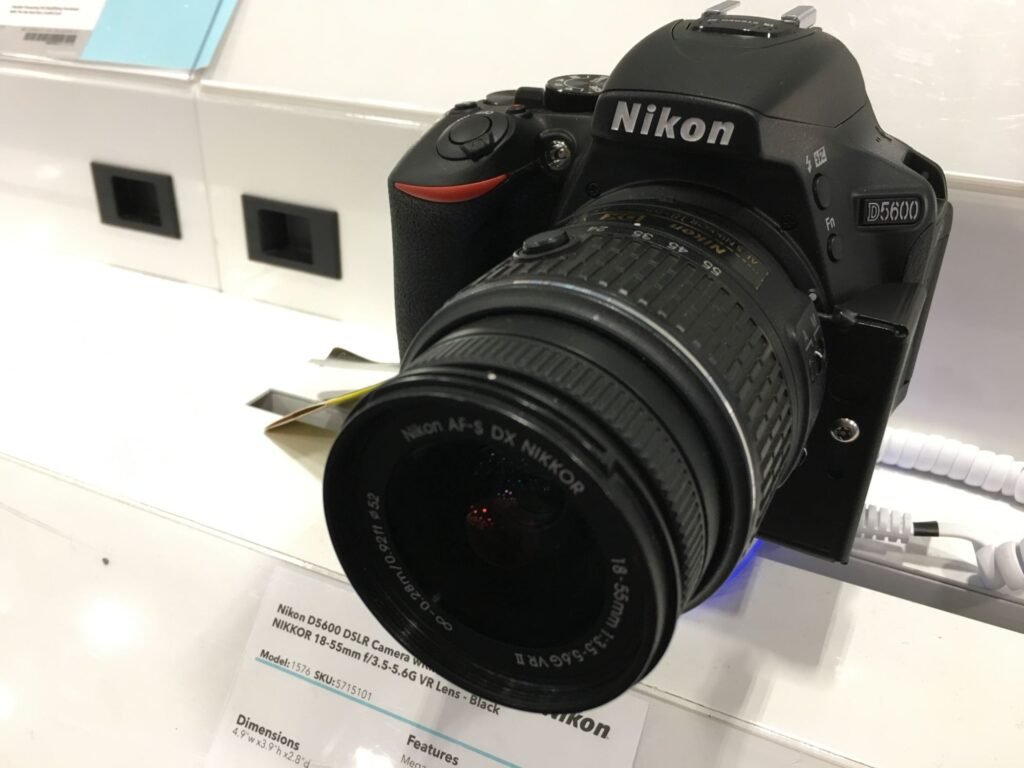
The D5600 belongs to Nikon’s DX-format DSLR family and was aimed at beginners and enthusiasts who wanted to move beyond basic entry-level cameras. It combines a 24.2-megapixel APS-C/DX CMOS sensor, Nikon’s EXPEED 4 processor, a flexible touchscreen display, an optical viewfinder, and built-in wireless connectivity.
Rather than being designed primarily for extreme action photography, the D5600 focuses on everyday photography, travel, portraits, family pictures, landscapes, and learning photography.
A Quick Look at the Nikon D5600
The easiest way to understand the D5600 is to think of it as a lightweight enthusiast DSLR.
It provides many manual controls while remaining relatively approachable for someone moving up from a smartphone or basic camera.
Its 24.2MP sensor is capable of producing detailed photographs, while the camera’s relatively compact body makes it easier to carry during travel.
Another important feature is the 3.2-inch vari-angle touchscreen, which can be turned and positioned for different shooting angles.
The D5600 Makes the Most Sense For
- Beginners learning DSLR photography
- Travel photographers
- Family photography
- Portrait photography
- Landscape photography
- Hobby photographers
- Students
- Casual video creators
- Nikon users wanting a lightweight DSLR
The Sensor Is Still One of Its Best Features
Nikon equipped the D5600 with a 24.2MP DX-format CMOS sensor.
The sensor measures approximately 23.5 × 15.6 mm, placing it in Nikon’s APS-C/DX category.
For everyday photography, 24.2MP provides plenty of resolution. Images can be cropped to some extent while retaining useful detail, and the files remain more manageable than those from extremely high-resolution cameras.
The sensor also does not use an optical low-pass filter, which helps the camera preserve fine detail in suitable shooting conditions.
What Does the DX Format Mean?
The D5600’s DX sensor has a crop factor of approximately 1.5x compared with full-frame.
This has two practical consequences.
A wide-angle lens does not appear quite as wide as it would on a full-frame body, while telephoto lenses can provide a narrower field of view that is useful for distant subjects.
For example, a 300mm lens provides a field of view equivalent to approximately 450mm on a full-frame camera.
This can be helpful for photographing birds, animals, sports, and distant subjects without immediately purchasing extremely long lenses.
Image Quality in Everyday Use
The D5600 is primarily a still-photography camera, and this is where it performs particularly well.
At lower ISO settings, the sensor can produce detailed photographs with good color and tonal information.
The final image quality will naturally depend on the lens, exposure, lighting, JPEG/RAW settings, and post-processing.
For a beginner, upgrading from a kit lens to a better-quality lens can often produce a more noticeable improvement than changing camera bodies.
ISO: How Does It Handle Dark Conditions?
The standard ISO range of the D5600 is 100 to 25,600.
This gives photographers considerable flexibility when available light becomes limited.
For the cleanest images, lower ISO settings are preferable. As ISO increases, image noise gradually becomes more visible.
A fast lens can be especially useful in low-light conditions.
For example, a 35mm or 50mm prime lens with a wide aperture can allow the photographer to use faster shutter speeds without pushing ISO unnecessarily high.
Autofocus: Simple Enough for Beginners
The D5600 uses Nikon’s Multi-CAM 4800DX autofocus system with 39 AF points, including 9 cross-type points.
This is sufficient for many everyday photography situations.
It works well for subjects such as:
- People
- Family events
- Portraits
- Travel scenes
- Pets
- Children
- Street photography
- General outdoor photography
It is not as sophisticated as the autofocus systems found in newer professional cameras, particularly when it comes to advanced subject tracking.
For a beginner learning how autofocus works, however, the system provides plenty of capability.
Continuous Shooting: Where It Sits
The D5600 can shoot at approximately 5 frames per second.
That is reasonably useful for casual action photography.
It can capture short sequences of:
- Children running
- Pets playing
- Casual sports
- Outdoor activities
- Birds in relatively predictable situations
However, it is not intended to be a dedicated high-speed wildlife or professional sports body.
Photographers who regularly photograph birds in flight or very fast sports may want a camera such as the Nikon D500 or a newer mirrorless model.
A Screen That Helps You Experiment
One of the D5600’s most practical features is its 3.2-inch vari-angle touchscreen LCD.
The display can be rotated into different positions, which makes it easier to compose photographs from unusual angles.
For example, you can use it for:
Low-angle shots:
Place the camera close to the ground without lying down to see through the optical viewfinder.
High-angle shots:
Hold the camera above a crowd and tilt the display toward yourself.
Self-recording:
The articulating design can be useful when the camera is positioned toward the photographer.
The touchscreen also provides a more approachable way to navigate settings and select focus points.
Traditional Optical Viewfinder
The D5600 still gives photographers the classic DSLR shooting experience through an optical viewfinder.
This is useful when shooting outdoors in bright sunlight, where an LCD can sometimes be difficult to see clearly.
It also lets the photographer hold the camera against the face, which can provide a more stable shooting position.
The optical viewfinder offers approximately 95% frame coverage.
What About Video?
The D5600 can record Full HD video.
It supports Full HD recording at frame rates including up to 60p, depending on the selected recording mode.
For basic content creation, family videos, educational recordings, and casual YouTube projects, this can be sufficient.
However, there is one major limitation by modern standards:
There is no 4K video recording.
Someone purchasing the D5600 primarily for modern video production should therefore consider a newer camera.
SnapBridge and Wireless Connectivity
The D5600 supports Nikon’s SnapBridge ecosystem through built-in Bluetooth and Wi-Fi functionality.
Wireless connectivity can be useful for moving photographs to a compatible smartphone and for remote camera operation in supported situations.
For travel photographers, this can be particularly convenient because photographs can be shared without repeatedly removing the memory card.
Battery and Portability
The D5600 uses the EN-EL14a rechargeable lithium-ion battery.
One of the advantages of the camera is its relatively lightweight body.
The camera weighs approximately 465g with battery and memory card, making it significantly easier to carry than many professional DSLRs.
For travel photography, this can be a major advantage.
Adding a large telephoto lens will obviously increase the total weight of the system.
Memory Card
The D5600 uses a single SD memory-card slot supporting SD, SDHC, and SDXC cards.
For normal photography, one good-quality SD card is sufficient.
For important professional assignments such as weddings, however, some photographers prefer cameras with two card slots because a second card can be used for backup recording.
The D5600 is therefore better suited to hobby and enthusiast use than high-risk professional assignments where redundant storage is important.
Nikon F-Mount Gives You Plenty of Options
The D5600 uses Nikon’s F-mount system.
This gives owners access to a large selection of Nikon lenses and compatible third-party lenses.
For beginners, the lens choice can initially seem overwhelming. A simple approach is to select the lens according to the type of photography you actually do.
Everyday Photography
An 18–55mm-type kit lens is compact and inexpensive.
Travel
An 18–140mm-type zoom can provide considerably more flexibility without carrying several lenses.
Portraits
A 50mm f/1.8-type lens can be a strong affordable option, although autofocus compatibility should be checked for the specific lens.
Wildlife
A 70–300mm-type telephoto lens can provide useful reach.
Landscapes
A wide-angle lens can capture more of the scene, especially for architecture and expansive landscapes.
How Good Is the D5600 for Portraits?
The D5600 can be an excellent beginner portrait camera.
The DX sensor combined with a wide-aperture lens can produce pleasing background separation.
A 50mm lens is particularly useful for portraits where you want the subject to stand out from the surroundings.
For environmental portraits, a wider lens can show more of the person’s surroundings.
The camera’s 24.2MP resolution also provides enough detail for normal prints and online photography.
Taking the D5600 on a Trip
Travel is one area where the D5600’s relatively small body becomes an advantage.
It is lighter than many enthusiast and professional DSLRs while still offering interchangeable lenses.
A single versatile zoom can cover a large percentage of travel situations.
You can photograph:
- Buildings
- Landscapes
- Food
- People
- Street scenes
- Wildlife
- Family moments
- Night scenes
The built-in wireless functionality can then make sharing photographs with a smartphone easier.
Can It Handle Wildlife?
Yes, but with some limitations.
The 1.5x DX crop factor and compatibility with telephoto lenses are useful for wildlife photography.
However, the camera’s 5 fps burst rate and 39-point AF system are not designed for the most demanding action photography.
For a person occasionally photographing animals, the D5600 can be perfectly adequate.
For a dedicated bird photographer who regularly photographs fast birds in flight, a faster camera would be a better investment.
Landscape Photography
The D5600 is well suited to landscape photography.
The 24.2MP sensor provides plenty of detail, while the lightweight body is convenient when hiking to viewpoints.
A wide-angle lens can make a major difference.
For landscapes, it is also worth shooting RAW if you plan to edit photographs because RAW files provide greater flexibility for adjusting exposure, shadows, highlights, and white balance.
Beginner-Friendly Features
The D5600 includes features intended to help photographers learn.
Its scene modes can simplify photography for users who are not yet comfortable with manual exposure.
As confidence increases, the photographer can move toward:
- Aperture Priority
- Shutter Priority
- Manual exposure
- RAW shooting
- Manual ISO selection
- Advanced autofocus settings
This makes the D5600 suitable as a learning platform rather than simply a point-and-shoot camera.
D5600 Compared With Nikon D7500
The D7500 sits higher in Nikon’s DSLR lineup and is designed for more demanding photography. Feature Nikon D5600 Nikon D7500 Sensor 24.2MP DX 20.9MP DX Processor EXPEED 4 EXPEED 5 AF Points 39 51 Burst Speed 5 fps 8 fps Screen Vari-angle touchscreen Tilting touchscreen Video Full HD 4K UHD Body Weight Approx. 465g Approx. 720g Main Character Lightweight enthusiast Advanced enthusiast
The D7500 is the better choice for serious action and demanding photography, while the D5600 is more appealing when portability and simplicity are priorities.
D5600 Compared With Canon EOS 850D
The Canon EOS 850D is another APS-C DSLR aimed at enthusiasts and beginners.
The Canon offers a newer-generation feature set, including a 24.1MP sensor, DIGIC 8 processor, 45-point all-cross-type viewfinder autofocus, and 4K video.
The D5600’s strengths include its lightweight body, 24.2MP sensor, vari-angle screen, and Nikon’s extensive F-mount ecosystem.
The choice between them often comes down to lens availability, handling preferences, and price.
What the D5600 Does Particularly Well
Lightweight Design
At around 465g with battery and card, the camera is easy to carry compared with larger DSLRs.
High-Resolution Sensor
The 24.2MP sensor provides plenty of detail for everyday photography.
Articulating Touchscreen
The vari-angle display makes creative compositions easier.
Beginner-Friendly Operation
The camera provides automatic modes while still allowing users to gradually learn manual photography.
Good Lens Selection
Nikon F-mount provides access to many lenses across different price ranges.
Wireless Sharing
SnapBridge connectivity is useful for smartphone transfers and supported remote functions.
Where It Shows Its Age
The D5600 is no longer a cutting-edge camera.
Its main limitations today include:
- No 4K video
- Only 5 fps continuous shooting
- Single memory-card slot
- Older autofocus technology
- No in-body image stabilization
- DSLR body is larger than many modern mirrorless alternatives
- Optical viewfinder coverage is approximately 95%
These limitations do not make it a bad camera; they simply show that it belongs to an older generation.
Should You Buy a Nikon D5600 Today?
There is no single answer because it depends heavily on the price and your intended use.
A clean D5600 can still make sense if you want an inexpensive interchangeable-lens camera mainly for photography.
It becomes especially attractive when purchased with a good lens rather than as a body-only deal.
For someone moving from smartphone photography, it can provide a substantial learning experience.
However, if you are primarily interested in video, advanced autofocus, or future-proof technology, a newer mirrorless camera will generally be a better investment.
What to Check Before Buying Used
If you are considering a second-hand D5600, don’t judge the camera only by its external appearance.
Check the shutter
Make sure the camera operates normally and doesn’t show unusual errors.
Inspect the sensor
Look for scratches, unusual marks, or persistent spots.
Test autofocus
Try focusing on both nearby and distant subjects.
Test the touchscreen
Check whether all areas of the screen respond correctly.
Examine the articulating mechanism
The screen should move smoothly without excessive looseness.
Test the memory-card slot
Confirm that the camera can read and write photographs correctly.
Check the battery
An old battery may have substantially reduced capacity.
Inspect the lens mount
Make sure lenses attach securely and communicate correctly with the camera.
Ideal D5600 Setup for Different Photographers
Photographer Suggested Approach Beginner D5600 + 18–55mm Travel D5600 + 18–140mm-type zoom Portrait D5600 + fast 50mm-type prime Wildlife D5600 + 70–300mm-type telephoto Landscape D5600 + wide-angle lens Family D5600 + standard zoom Casual Video D5600 + kit lens + external microphone
My Take on the Nikon D5600
The D5600 is not a camera that tries to win on speed or professional specifications. Its appeal is different.
It offers a large 24.2MP DX sensor, lightweight handling, an articulating touchscreen, interchangeable lenses, and enough manual control to teach serious photography.
For a beginner, that combination can be more valuable than a camera overloaded with advanced professional features.
The biggest question today is price. If a newer camera is only slightly more expensive, the newer model may provide better long-term value. But if you find the D5600 at a good used price, it can still be a very capable photography tool.
Final Score
Area Score Photo Quality 4.5/5 Beginner Friendliness 4.7/5 Portability 4.8/5 Portraits 4.4/5 Landscapes 4.5/5 Travel 4.7/5 Wildlife 3.9/5 Video 3.5/5 Autofocus 4.0/5 Overall 4.3/5
Nikon D5600 FAQs
Is the Nikon D5600 a full-frame camera?
No. It is a DX-format APS-C DSLR with a crop factor of approximately 1.5x.
How many megapixels does the D5600 have?
The camera features a 24.2-megapixel CMOS sensor.
Does Nikon D5600 have 4K video?
No. Its video recording capability is Full HD.
Is the Nikon D5600 good for beginners?
Yes. Its automatic modes, touchscreen interface, manual controls, and relatively lightweight body make it suitable for people learning photography.
Is D5600 good for portraits?
Yes. With a suitable fast lens, it can produce detailed portraits with attractive background separation.
Can the D5600 photograph wildlife?
Yes. It can be used for wildlife, especially with a telephoto lens, although its 5 fps shooting speed and autofocus system are less suited to demanding action than higher-end cameras.
Does the D5600 have Wi-Fi?
Yes. It supports wireless connectivity through Nikon’s SnapBridge system, including Bluetooth and Wi-Fi functionality.
Does Nikon D5600 have a flip screen?
It has a vari-angle LCD screen that can be rotated and positioned for different shooting angles.
What lens mount does the D5600 use?
The camera uses Nikon’s F mount and supports compatible Nikon lenses and third-party F-mount lenses.
Is Nikon D5600 still worth buying?
It can be worth considering as an affordable used DSLR for photography, particularly for beginners and travelers. For 4K video or advanced modern autofocus, a newer camera is preferable.
Conclusion
The Nikon D5600 remains a practical entry point into interchangeable-lens photography. Its 24.2MP DX sensor, lightweight construction, vari-angle touchscreen, optical viewfinder, and broad lens compatibility give beginners plenty of room to develop their skills.
It is not the right choice for every photographer. Professionals needing extremely fast autofocus, high burst rates, dual-card redundancy, or advanced video should look at more modern equipment.
But for someone who wants to learn photography, take high-quality photographs, travel with a relatively light DSLR, and explore different lenses, the D5600 still has plenty to offer.