Canon EOS 80D Review: Full Specifications, Features, Price, Pros and Cons
The Canon EOS 80D is a well-rounded DSLR camera designed for photographers and video creators who want a strong combination of image quality, autofocus performance, handling, and connectivity. Although it is an older DSLR, the 80D remains an interesting option for beginners, enthusiasts, portrait photographers, travel photographers, and users who prefer Canon’s traditional optical viewfinder experience.
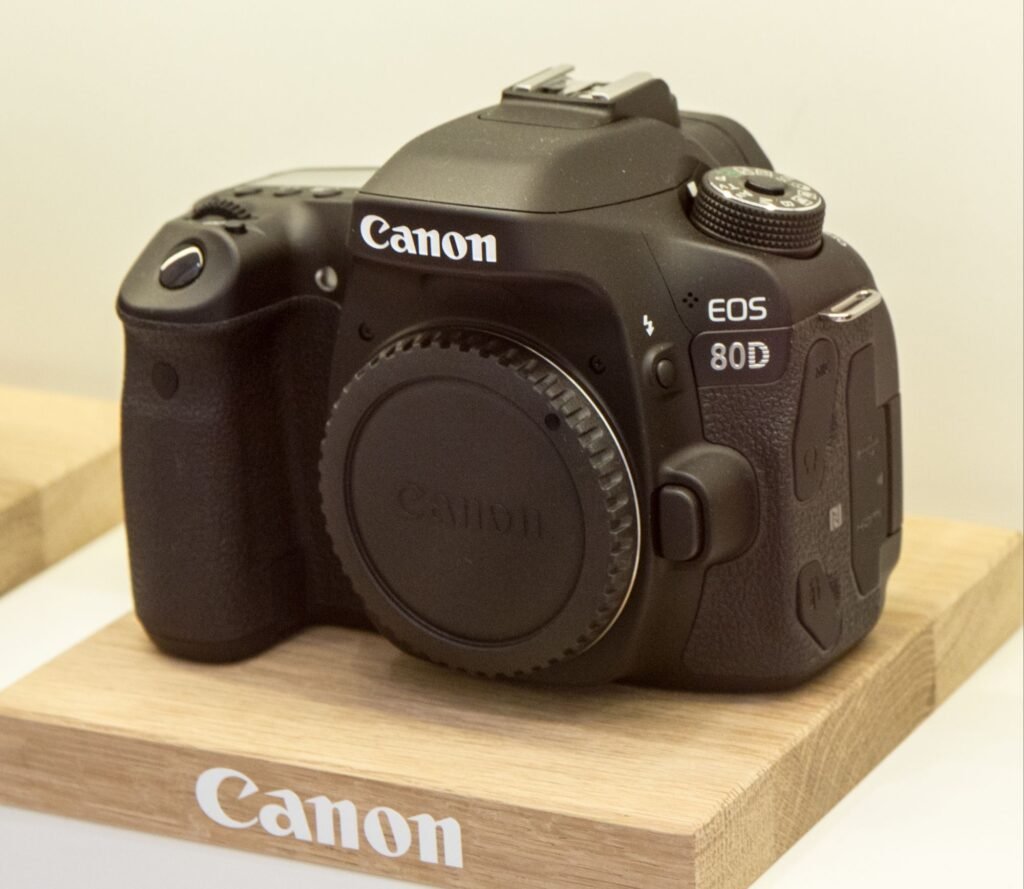
With a 24.2-megapixel APS-C CMOS sensor, Canon’s DIGIC 6 image processor, a 45-point all-cross-type autofocus system, and continuous shooting at approximately 7 frames per second, the EOS 80D offers capable performance for a wide range of photography situations.
Canon EOS 80D Overview
The Canon EOS 80D was developed as an enthusiast-oriented APS-C DSLR. It sits above Canon’s entry-level DSLR models and provides more advanced controls, better autofocus capabilities, and a more robust body.
One of its biggest strengths is its autofocus system. The camera features 45 all-cross-type AF points, which can help provide reliable focusing when photographing moving subjects.
For video users, the EOS 80D also supports Full HD recording, and its Dual Pixel CMOS AF system provides smooth autofocus during Live View and video shooting.
Canon EOS 80D Key Specifications
Specification Canon EOS 80D Camera Type DSLR Sensor APS-C CMOS Resolution 24.2 MP Image Processor DIGIC 6 ISO Range 100–16,000 Expanded ISO Up to 25,600 Autofocus 45-point all-cross-type AF Continuous Shooting Approx. 7 fps Maximum Shutter Speed 1/8000 sec Video Full HD Display 3.0-inch Vari-angle touchscreen Viewfinder Optical Connectivity Wi-Fi, NFC Lens Mount Canon EF / EF-S Storage SD/SDHC/SDXC Battery LP-E6N / LP-E6 compatible Weight Approx. 730 g with battery and card
24.2MP APS-C Sensor
The Canon EOS 80D uses a 24.2-megapixel APS-C CMOS sensor. This provides enough resolution for detailed photographs and gives users flexibility when cropping images.
The APS-C sensor also provides Canon’s familiar 1.6x crop factor, which can be particularly useful for wildlife and sports photography because telephoto lenses effectively provide a narrower field of view.
For everyday photography, landscapes, portraits, travel, events, and wildlife, the sensor can still produce very good results when paired with a quality lens and proper exposure.
DIGIC 6 Image Processor
Canon equipped the EOS 80D with the DIGIC 6 image processor.
The processor handles image processing, autofocus-related operations, noise reduction, continuous shooting, and video functions.
It also helps the camera maintain responsive operation when shooting at higher speeds.
ISO Performance and Low-Light Photography
The EOS 80D provides a standard ISO range of 100 to 16,000, with expansion available up to ISO 25,600.
At lower ISO settings, the camera can produce clean and detailed images with good dynamic range. As ISO increases, image noise becomes more noticeable, particularly in very dark conditions.
For indoor photography, events, evening photography, and low-light situations, using a fast lens can significantly improve results.
A lens with a wide aperture, such as an f/1.8 or f/2.8 lens, can allow more light to reach the sensor and reduce the need to use extremely high ISO settings.
45-Point All-Cross-Type Autofocus System
Autofocus is one of the EOS 80D’s strongest features.
The camera has a 45-point all-cross-type AF system through the optical viewfinder. Cross-type AF points are designed to detect focus using both horizontal and vertical detail, helping the system acquire focus reliably across a variety of subjects.
This makes the 80D suitable for:
- Sports photography
- Wildlife photography
- Bird photography
- Children and pets
- Events
- Portraits
- Action photography
The camera also offers different autofocus-area options, allowing photographers to choose an AF configuration according to the subject.
Dual Pixel CMOS AF
For Live View photography and video recording, the EOS 80D uses Canon’s Dual Pixel CMOS AF technology.
This is particularly useful for video because it allows smoother and more natural autofocus transitions compared with many older contrast-detection-only systems.
For creators who frequently record themselves, family videos, interviews, demonstrations, or moving subjects, Dual Pixel CMOS AF can make focusing much easier.
7 FPS Continuous Shooting
The Canon EOS 80D can shoot at approximately 7 frames per second.
This is fast enough for many enthusiast-level applications, including:
- Sports
- Wildlife
- Birds
- Action
- Children
- Events
- Motorsport
While newer mirrorless cameras can be considerably faster, 7 fps remains useful for capturing short bursts of movement.
1/8000 Second Maximum Shutter Speed
The camera offers a maximum shutter speed of 1/8000 second.
This is useful when photographing fast-moving subjects or shooting with wide apertures in bright outdoor conditions.
For example, when using a portrait lens at a wide aperture under strong sunlight, the fast shutter speed can help prevent overexposure.
Full HD Video Recording
The EOS 80D supports Full HD video recording.
Although it does not offer modern 4K recording, its Full HD capabilities remain useful for basic video production, YouTube content, interviews, educational videos, family recordings, and other applications where 1080p is sufficient.
The camera’s Dual Pixel CMOS AF is especially helpful during video recording because it can provide smoother focus transitions.
The 80D also includes microphone and headphone connectivity, making it more practical for serious video recording than many entry-level DSLRs.
Vari-Angle Touchscreen Display
The camera features a 3.0-inch vari-angle touchscreen LCD.
The articulating display is useful when shooting from unusual angles, such as:
- Low-angle photography
- High-angle photography
- Vlogging-style setups
- Self-recording
- Product photography
- Video production
The touchscreen also makes it easier to select focus points and navigate certain camera functions.
Optical Viewfinder
Unlike a mirrorless camera, the EOS 80D provides an optical DSLR viewfinder.
The optical viewfinder allows photographers to see the subject directly through the lens via the camera’s optical system.
For wildlife, sports, and outdoor photography, many photographers still prefer the natural viewing experience of an optical viewfinder.
Build Quality and Handling
The EOS 80D has a more substantial build and control layout than Canon’s basic entry-level DSLR models.
Its physical controls allow photographers to change important settings without constantly entering menus.
This is particularly useful when photographing changing subjects because shutter speed, aperture, ISO, autofocus settings, and other controls can be adjusted quickly.
The camera is also designed with some dust- and moisture-resistant construction, although it should not be treated as waterproof.
Battery Life
The EOS 80D uses Canon’s LP-E6N battery, with compatibility with the LP-E6 family.
Battery performance depends on how the camera is used. Frequent Live View operation, video recording, Wi-Fi use, and heavy autofocus activity can reduce battery life compared with optical-viewfinder shooting.
For long photography sessions, carrying a spare battery is recommended.
Storage
The EOS 80D uses SD, SDHC, and SDXC memory cards.
A fast and reliable SD card is recommended, especially when shooting continuous bursts or recording video.
Before purchasing a used EOS 80D, it is worth checking the condition of the memory-card slot and confirming that the camera reads and writes cards correctly.
Wi-Fi and NFC Connectivity
The EOS 80D includes built-in Wi-Fi and NFC connectivity.
These features can make transferring photographs to compatible devices more convenient and can also provide remote-control functionality depending on the connected device and Canon’s supported software.
For travel photographers and casual users, wireless connectivity can reduce the need to remove the memory card every time an image needs to be transferred.
Canon EF and EF-S Lens Compatibility
The EOS 80D uses Canon’s EF mount, and it is compatible with both EF and EF-S lenses.
This gives photographers access to a large selection of Canon lenses.
Some useful lens categories include:
- 18–55mm zoom lenses for beginners
- 18–135mm lenses for travel
- 24mm or 35mm lenses for everyday photography
- 50mm lenses for portraits
- 85mm lenses for portrait photography
- 55–250mm lenses for wildlife and outdoor photography
- 70–200mm lenses for sports and events
- Macro lenses for close-up photography
The large EF/EF-S ecosystem is one reason the EOS 80D can still be attractive on the used market.
Canon EOS 80D for Portrait Photography
The EOS 80D can be an excellent portrait camera when paired with a suitable lens.
A 50mm or 85mm lens can provide attractive subject separation, while the 24.2MP sensor provides plenty of resolution for portraits.
For better background blur, photographers should consider lenses with wider apertures such as f/1.8, f/1.4, or f/2.
Canon EOS 80D for Wildlife Photography
Wildlife is another area where the EOS 80D performs well.
Its APS-C sensor provides a 1.6x crop factor, which can be useful with telephoto lenses. The 45-point autofocus system and approximately 7 fps burst shooting also make it capable of photographing moving animals.
For birds and distant wildlife, a 300mm, 400mm, or similar telephoto lens can provide significantly more reach.
Canon EOS 80D for Sports Photography
For sports photography, autofocus performance and continuous shooting speed are important.
The 80D’s 45-point all-cross-type AF system and approximately 7 fps continuous shooting make it suitable for many amateur and enthusiast sports applications.
However, professional sports photographers who require extremely high burst rates, advanced subject tracking, or modern high-speed mirrorless autofocus may prefer newer cameras.
Canon EOS 80D for Travel Photography
The EOS 80D can be used effectively for travel photography, particularly when paired with an all-purpose zoom lens.
A lens such as an 18–135mm-type zoom can cover a wide range of subjects without requiring frequent lens changes.
The vari-angle touchscreen and built-in wireless connectivity are also useful for travel creators.
The main disadvantage for travel is its DSLR size and weight compared with modern compact mirrorless cameras.
Canon EOS 80D for YouTube and Video
The EOS 80D can still be useful for YouTube and Full HD video production.
Its key advantages include:
- Dual Pixel CMOS AF
- Vari-angle screen
- External microphone support
- Headphone monitoring
- Full HD recording
- Interchangeable lenses
However, creators who specifically require 4K, advanced stabilization, or modern subject-tracking autofocus should consider newer mirrorless models.
Canon EOS 80D Pros and Cons
Pros
- 24.2MP APS-C sensor
- Good overall image quality
- 45-point all-cross-type AF system
- Approximately 7 fps continuous shooting
- Dual Pixel CMOS AF
- Vari-angle touchscreen
- Optical viewfinder
- 1/8000 sec maximum shutter speed
- Wi-Fi and NFC
- Large EF/EF-S lens ecosystem
- External microphone and headphone connectivity
- Comfortable DSLR handling
Cons
- No 4K video
- Relatively large and heavy compared with modern mirrorless cameras
- Older DIGIC 6 processor
- Single memory-card slot
- No built-in image stabilization
- Live View battery life is lower than optical-viewfinder shooting
- Newer cameras offer more advanced subject detection and tracking
Canon EOS 80D vs Canon EOS 90D
The EOS 90D is the newer and more advanced successor in this product family. Feature Canon EOS 80D Canon EOS 90D Sensor 24.2MP APS-C 32.5MP APS-C Processor DIGIC 6 DIGIC 8 Viewfinder AF 45-point 45-point all-cross-type Continuous Shooting Approx. 7 fps Approx. 10 fps Video Full HD 4K Screen Vari-angle touchscreen Vari-angle touchscreen Connectivity Wi-Fi/NFC Wi-Fi/Bluetooth Overall Older enthusiast DSLR More advanced DSLR
If the price difference is small, the EOS 90D is generally the more capable choice. However, a significantly cheaper EOS 80D can still provide excellent value for photography.
Canon EOS 80D vs Nikon D7500
The Nikon D7500 is another enthusiast APS-C DSLR. Feature Canon EOS 80D Nikon D7500 Resolution 24.2MP 20.9MP Sensor APS-C APS-C/DX Burst Speed Approx. 7 fps Approx. 8 fps Video Full HD 4K UHD Autofocus 45-point all-cross-type 51-point Screen Vari-angle touchscreen Tilting touchscreen Lens System Canon EF/EF-S Nikon F Best For General photography/video Action and wildlife
Both cameras are capable enthusiast DSLRs. The better choice often depends on the lenses already owned and personal preference for Canon or Nikon controls.
Is the Canon EOS 80D Still Worth Buying?
The EOS 80D can still be worth buying, particularly if you find a clean used example at a reasonable price.
It makes the most sense for photographers who:
- Want an affordable DSLR
- Prefer an optical viewfinder
- Already own Canon EF/EF-S lenses
- Mainly photograph still images
- Need reliable autofocus
- Want a vari-angle screen
- Do not require 4K video
It is less attractive for users who want the latest mirrorless autofocus, 4K/6K video, compact size, or advanced AI-based subject recognition.
Who Should Buy the Canon EOS 80D?
The EOS 80D is a good option for:
- Beginner photographers upgrading from entry-level cameras
- Photography students
- Portrait photographers
- Wildlife enthusiasts
- Travel photographers
- Event photographers
- Amateur sports photographers
- Full HD video creators
- Canon users with existing EF/EF-S lenses
Who Should Avoid the Canon EOS 80D?
You may want a newer camera if you need:
- 4K video
- Very fast burst shooting
- Advanced animal and bird detection
- Modern mirrorless autofocus
- In-body image stabilization
- Smaller and lighter equipment
- Advanced professional video features
Recommended Lenses for Canon EOS 80D
The right lens can make a bigger difference than upgrading the camera body.
For general photography, an 18–135mm-type zoom is a practical choice.
For portraits, a 50mm f/1.8 or 85mm-type lens can provide attractive background separation.
For wildlife and birds, a 55–250mm or longer telephoto lens is more appropriate.
For low-light and indoor photography, a fast prime lens such as a 24mm, 35mm, or 50mm f/1.8 can be an excellent addition.
Used Canon EOS 80D Buying Checklist
Because the EOS 80D is an older DSLR, many units are now available second-hand.
Before purchasing a used camera, check:
- Shutter count – Ask for the camera’s approximate shutter usage.
- Sensor condition – Check for scratches, stains, or unusual marks.
- Lens mount – Confirm that lenses mount securely.
- Autofocus – Test autofocus through the optical viewfinder and Live View.
- Touchscreen – Check the entire display for dead areas.
- Memory-card slot – Confirm reliable card reading and writing.
- Battery – Check whether the battery holds a reasonable charge.
- Ports – Test USB, HDMI, microphone, and headphone connections if needed.
- Wi-Fi/NFC – Check connectivity if wireless functions are important.
- Body condition – Look for signs of water damage or serious impact.
A clean camera with a healthy sensor, working autofocus, and good battery can be much more valuable than a heavily worn example sold at a slightly lower price.
Canon EOS 80D Final Verdict
The Canon EOS 80D remains a capable enthusiast DSLR despite its age. Its 24.2MP APS-C sensor, 45-point all-cross-type autofocus system, approximately 7 fps burst shooting, Dual Pixel CMOS AF, vari-angle touchscreen, and extensive EF/EF-S lens compatibility make it a versatile camera.
Its biggest weaknesses by modern standards are the lack of 4K video, older processing technology, DSLR size, and the absence of newer subject-recognition autofocus.
For photography-focused users who can find a well-maintained used unit at a good price, the EOS 80D can still be a practical and enjoyable camera.
Canon EOS 80D Rating
Category Rating Image Quality 4.5/5 Autofocus 4.5/5 Wildlife Photography 4.3/5 Portrait Photography 4.5/5 Video 3.8/5 Build Quality 4.5/5 Battery Performance 4.3/5 Connectivity 4.0/5 Value on Used Market 4.4/5 Overall 4.3/5
Frequently Asked Questions
1. Is Canon EOS 80D a full-frame camera?
No. The Canon EOS 80D uses an APS-C CMOS sensor. It has a 1.6x crop factor compared with a full-frame camera.
2. How many megapixels does the Canon EOS 80D have?
The EOS 80D has a 24.2-megapixel APS-C CMOS sensor.
3. Does Canon EOS 80D record 4K video?
No. The EOS 80D is a Full HD camera and does not provide 4K video recording.
4. Is Canon EOS 80D good for wildlife photography?
Yes. Its APS-C sensor, 45-point autofocus system, 1.6x crop factor, and approximately 7 fps continuous shooting make it suitable for enthusiast wildlife photography.
5. Is Canon EOS 80D good for portraits?
Yes. The 24.2MP sensor can produce detailed portraits, and pairing the camera with a fast prime lens can provide attractive background blur.
6. Does Canon EOS 80D have a touchscreen?
Yes. It has a 3.0-inch vari-angle touchscreen LCD.
7. Does Canon EOS 80D have Wi-Fi?
Yes. The EOS 80D includes Wi-Fi and NFC connectivity.
8. What lenses work with Canon EOS 80D?
The camera supports Canon EF and EF-S lenses. There are many compatible wide-angle, standard, telephoto, macro, and prime lenses.
9. Is Canon EOS 80D good for beginners?
Yes. It can be a good choice for beginners who want to learn manual photography and grow into more advanced DSLR controls.
10. Is Canon EOS 80D still worth buying?
Yes, especially as a reasonably priced used camera for photography. However, users who need 4K video or modern mirrorless autofocus should consider newer models.
Conclusion
The Canon EOS 80D is a versatile APS-C DSLR that combines good image quality, dependable autofocus, comfortable controls, and useful video features. While newer cameras have surpassed it in areas such as video resolution and intelligent autofocus, the 80D remains a solid option for photographers who want an affordable Canon DSLR with access to the extensive EF and EF-S lens ecosystem.