Nikon D780 Review: Full Specifications, Features, Performance, Pros and Cons
The Nikon D780 is a full-frame DSLR camera designed for photographers who want a combination of excellent image quality, dependable autofocus, strong low-light performance, professional handling, and versatile video capabilities.
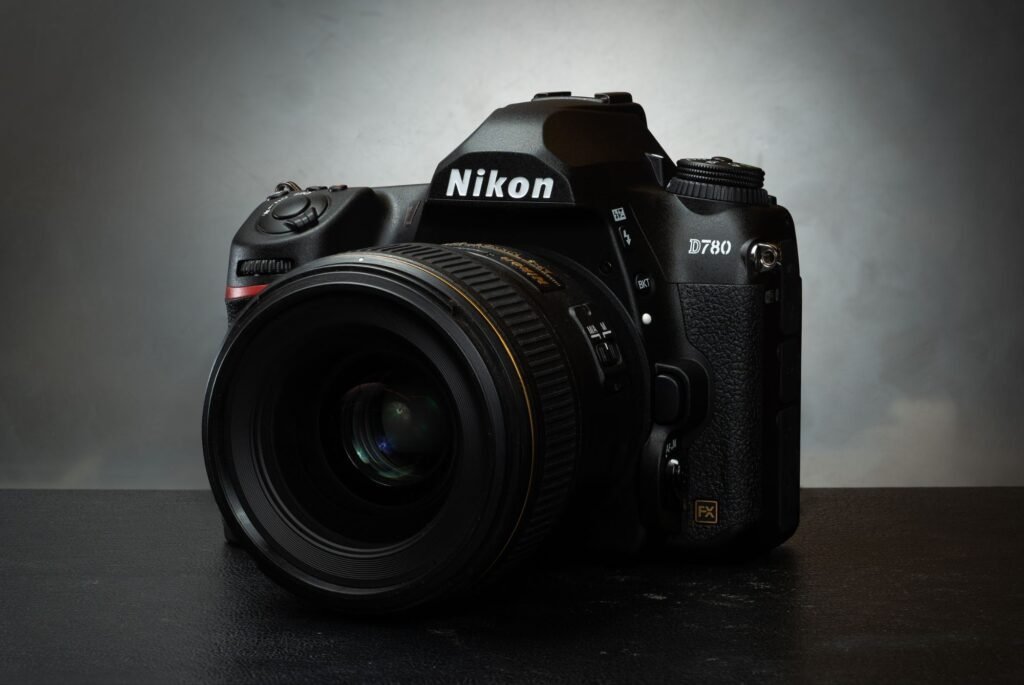
Introduced as a successor to the popular Nikon D750, the D780 combines the traditional DSLR experience of an optical viewfinder with several modern technologies. It features a 24.5-megapixel FX-format full-frame CMOS sensor, Nikon’s EXPEED 6 image-processing engine, a 51-point viewfinder autofocus system, advanced Live View autofocus, fast continuous shooting, and 4K UHD video recording.
The camera is suitable for a wide range of photography, including portraits, weddings, landscapes, travel, events, street photography, studio work, and wildlife.
For photographers who prefer the optical viewfinder and battery efficiency of a DSLR but still want modern Live View and video capabilities, the Nikon D780 remains an interesting option.
Nikon D780 Overview
The Nikon D780 is a full-frame DSLR built around a 24.5MP FX-format sensor.
Rather than simply being a minor upgrade to the D750, the D780 incorporates several technologies inspired by Nikon’s mirrorless camera development. This is particularly noticeable when using Live View, where the camera provides sensor-based autofocus with eye-detection capabilities for still photography.
The result is a DSLR that can be used in two different ways.
Through the optical viewfinder, it behaves like a traditional Nikon DSLR. When Live View is activated, it offers a more modern shooting experience with touchscreen control and sensor-based autofocus.
This combination makes the D780 particularly versatile.
Nikon D780 Key Specifications
Feature Nikon D780 Camera Type Full-frame DSLR Sensor FX-format CMOS Effective Resolution 24.5 MP Sensor Size Approximately 35.9 × 23.9 mm Processor EXPEED 6 Lens Mount Nikon F Native ISO 100–51,200 Expanded ISO Approximately 50–204,800 Viewfinder AF 51-point AF system Live View AF Hybrid autofocus with 273 focus points Continuous Shooting Up to 7 fps Maximum Shutter Speed 1/8000 sec Video 4K UHD 4K Frame Rates Up to 30p Display 3.2-inch tilting touchscreen LCD Wi-Fi Yes Bluetooth Yes GPS No built-in GPS Memory Cards Dual SD card slots Battery EN-EL15b rechargeable Li-ion Body Material Magnesium alloy and carbon-fibre composite Weather Resistance Yes Approx. Weight 840 g
Specifications can vary depending on accessories, battery, firmware, and shooting mode.
24.5-Megapixel Full-Frame Sensor
The D780’s 24.5MP FX-format sensor offers a good balance between resolution, image quality, and file size.
While cameras such as the Nikon D850 provide substantially higher resolution, the D780’s 24.5MP sensor can be advantageous for photographers who shoot large numbers of photographs.
Smaller files can make storage, backup, and editing more manageable.
The full-frame sensor is also useful for low-light photography and provides the traditional full-frame field of view associated with Nikon FX cameras.
The sensor works well for:
- Portrait photography
- Wedding photography
- Landscape photography
- Travel photography
- Event photography
- Street photography
- Studio photography
- Wildlife photography
Image Quality
Image quality is one of the major strengths of the Nikon D780.
The camera produces detailed photographs with good dynamic range and attractive color reproduction.
At lower ISO settings, the sensor can capture a wide range of tones, which is particularly useful for landscapes and scenes with challenging highlights and shadows.
The relatively moderate 24.5MP resolution also means that RAW files are easier to manage than the very large files produced by some ultra-high-resolution cameras.
For photographers who need a practical combination of image quality and workflow efficiency, the D780’s resolution can be a strong advantage.
Nikon D780 Low-Light Performance
The D780 is designed to perform well in challenging lighting conditions.
Its native ISO range extends from ISO 100 to ISO 51,200, with expanded settings available beyond the standard range.
This makes the camera suitable for:
- Night photography
- Indoor events
- Wedding receptions
- Concert photography
- Low-light portraits
- Street photography
- Travel photography
A fast lens can further improve low-light performance.
For example, pairing the D780 with a fast 50mm or 85mm prime lens can provide excellent results for indoor portraits and events.
Nikon D780 Autofocus System
The D780 uses different autofocus systems depending on how the camera is being operated.
When using the optical viewfinder, the camera provides a 51-point autofocus system.
When shooting through Live View, it uses a sensor-based hybrid autofocus system with 273 focus points.
Live View autofocus is one of the important improvements over the older D750.
The camera also supports eye-detection autofocus during Live View still photography, making it particularly useful for portraits.
This gives the D780 greater flexibility than a traditional DSLR that relies primarily on viewfinder autofocus.
Continuous Shooting
The Nikon D780 can shoot at up to 7 frames per second using the optical viewfinder.
This is fast enough for many types of photography.
For example:
- Wedding photographers can capture important moments.
- Event photographers can record short action sequences.
- Wildlife photographers can capture animal movement.
- Street photographers can shoot rapidly changing scenes.
The camera also provides additional shooting options when using Live View.
However, photographers who specialize primarily in professional sports or very fast wildlife may prefer a camera specifically designed for high-speed action.
Nikon D780 Video Capabilities
The D780 provides 4K UHD video recording, making it useful for photographers who also create video content.
The camera can record 4K UHD footage at frame rates including 30p, 25p, and 24p.
This makes it suitable for:
- YouTube videos
- Interviews
- Travel videos
- Wedding videos
- Product videos
- Short films
- Documentary projects
- Educational content
The camera also provides Full HD recording options at higher frame rates.
One advantage of the D780 is that its Live View autofocus system can provide more useful focusing behavior for video than older DSLR systems.
However, modern mirrorless cameras generally provide more advanced video features, making them a better choice for users whose primary goal is professional video production.
4K UHD Video
The ability to record 4K UHD video makes the D780 more versatile than many older DSLRs.
4K footage provides significantly more resolution than Full HD, allowing users to create sharper video and giving editors additional flexibility for cropping or reframing in post-production.
For a photographer who occasionally creates YouTube content or client videos, this can be a useful feature.
Nikon D780 Display
The camera has a 3.2-inch tilting touchscreen LCD.
The tilting design is useful when photographing from low or high angles.
For example, landscape photographers can tilt the screen when working close to the ground, while photographers shooting above crowds can use it to help compose images.
The touchscreen also makes it easier to navigate menus, review photographs, and select focus points during Live View.
Optical Viewfinder
One of the main reasons to choose the D780 instead of a mirrorless camera is its optical viewfinder.
The optical viewfinder provides a direct view through the camera’s lens without using an electronic display.
Many photographers prefer this experience because it provides:
- Natural real-time viewing
- No electronic viewfinder lag
- Low power consumption
- Familiar DSLR handling
- Clear subject visibility in bright conditions
For photographers who enjoy traditional DSLR photography, this remains an important advantage.
Nikon D780 Build Quality
The D780 is designed for serious photography and features a durable body.
Its construction includes magnesium alloy and carbon-fibre composite materials, with sealing designed to provide protection against dust and moisture.
This makes it suitable for outdoor photography and professional assignments.
It can be used for:
- Travel
- Outdoor weddings
- Landscape photography
- Events
- Street photography
- Commercial photography
However, weather sealing does not mean the camera is waterproof. Additional protection should be used during heavy rain or extreme weather.
Battery Life
Battery life is one of the D780’s notable strengths.
Because optical-viewfinder photography consumes less power than extensive Live View operation, the camera can deliver a long shooting session on a single battery under suitable conditions.
The camera uses the EN-EL15b battery system, while compatible batteries from the same family can also be supported depending on configuration.
Actual battery performance depends on:
- Live View usage
- Video recording
- Autofocus
- Image review
- Wireless connectivity
- Temperature
- Shooting settings
Professional photographers should still carry at least one spare battery.
Dual Memory Card Slots
The Nikon D780 provides two SD card slots.
This is particularly useful for photographers who want additional storage flexibility.
The second card can be used for:
- Backup recording
- Overflow storage
- Separating RAW and JPEG files
For professional wedding and event photographers, having two card slots can provide an additional layer of protection against card failure.
Photographers should still regularly back up important photographs.
Wi-Fi and Bluetooth
The D780 supports wireless connectivity through Wi-Fi and Bluetooth.
These features can be useful for connecting the camera to compatible smartphones and other devices.
Wireless connectivity can make it easier to:
- Transfer photographs
- Share images
- Remotely control the camera
- Upload selected images
- Review photographs on a mobile device
This can be particularly convenient for travel photographers and content creators.
Nikon F-Mount Lens Compatibility
The D780 uses Nikon’s F-mount, which provides access to a huge selection of NIKKOR lenses.
This is a significant advantage for photographers who already own Nikon DSLR equipment.
Available lens categories include:
- Wide-angle lenses
- Standard zooms
- Telephoto lenses
- Prime lenses
- Macro lenses
- Super-telephoto lenses
- Professional NIKKOR lenses
The large F-mount ecosystem means photographers can build a highly specialized system around the D780.
Nikon D780 for Wedding Photography
The D780 is a strong camera for wedding photography.
Wedding photographers often need a combination of:
- Good low-light performance
- Reliable autofocus
- Fast shooting
- High-quality RAW files
- Long battery life
- Durable construction
- Dual card slots
The D780 provides all of these features.
Its 24.5MP resolution is also practical for weddings because photographers can shoot large numbers of photographs without producing extremely large files.
For wedding work, lenses such as a 24-70mm f/2.8 and 70-200mm f/2.8 can make a versatile combination.
Nikon D780 for Portrait Photography
The D780 is excellent for portrait photography.
Its full-frame sensor works particularly well with fast prime lenses.
An 85mm lens can provide attractive facial perspective and background separation, while a 50mm lens can be useful for environmental portraits.
Live View eye-detection autofocus can also be useful when photographing people.
The combination of a full-frame sensor and fast lenses allows photographers to create images with strong subject separation.
Nikon D780 for Landscape Photography
Landscape photographers can benefit from the D780’s full-frame sensor and strong image quality.
A wide-angle lens can be used to capture expansive scenes, while the camera’s dynamic range provides flexibility when editing photographs containing bright skies and darker foregrounds.
A tripod can further improve image quality during long-exposure landscape photography.
For landscapes, photographers can also take advantage of the camera’s low native ISO setting.
Nikon D780 for Wildlife Photography
The D780 can be used successfully for wildlife photography.
Its 7 fps continuous shooting and 51-point viewfinder autofocus system provide useful performance for moving subjects.
The 24.5MP sensor also offers enough resolution for many wildlife applications.
However, serious wildlife photographers may prefer cameras with faster burst rates and more advanced subject-recognition autofocus.
A high-quality telephoto lens is also essential.
A 200-500mm-class or similar lens can provide the reach required for photographing distant animals.
Nikon D780 for Travel Photography
The D780 is capable of producing excellent travel photographs.
Its full-frame sensor provides strong image quality, while the durable body is suitable for outdoor use.
However, the camera is not particularly small or lightweight.
Travel photographers who prioritize portability may prefer a mirrorless camera or smaller DSLR.
For photographers who prioritize image quality and traditional DSLR handling over size, the D780 can still be a very capable travel camera.
Nikon D780 for Studio Photography
Studio photographers can benefit from the camera’s full-frame sensor and 24.5MP resolution.
The D780 is suitable for:
- Fashion photography
- Portraits
- Product photography
- Commercial photography
- Catalog photography
- Editorial photography
With controlled studio lighting and a high-quality lens, the camera can produce professional-quality files.
Nikon D780 Pros and Cons
Pros
- Full-frame 24.5MP sensor
- Excellent image quality
- Strong high-ISO performance
- Good dynamic range
- 51-point optical-viewfinder autofocus
- 273-point Live View autofocus
- Eye-detection autofocus in Live View
- Up to 7 fps continuous shooting
- 4K UHD video
- 3.2-inch tilting touchscreen
- Dual SD card slots
- Wi-Fi and Bluetooth
- Strong battery life
- Durable weather-resistant construction
- Large selection of Nikon F-mount lenses
- Excellent for weddings and portraits
- Traditional optical viewfinder
Cons
- Large compared with many modern mirrorless cameras
- Relatively heavy for travel
- No built-in image stabilization
- Older F-mount lens ecosystem
- Video features are less advanced than many newer mirrorless cameras
- No built-in GPS
- Not designed specifically for high-speed sports photography
- DSLR technology is gradually being replaced by mirrorless systems
Nikon D780 vs Nikon D750
The D780 is the successor to the Nikon D750.
Both cameras use a 24MP-class full-frame sensor, but the D780 incorporates a newer image processor and improved Live View functionality.
The D780 provides:
- Newer processing
- Better Live View autofocus
- Eye-detection autofocus
- 4K video improvements
- Touchscreen functionality
- Updated connectivity
- Improved overall performance
The D750 can still be attractive as a lower-cost used full-frame DSLR, but the D780 is the more modern option.
Nikon D780 vs Nikon D850
The D850 is positioned above the D780 in terms of resolution and professional capability.
The D850 provides a much higher-resolution 45.7MP sensor, while the D780 uses 24.5MP.
The D850 is therefore better suited to photographers who need maximum detail and significant cropping flexibility.
The D780, however, can be more practical for photographers who want smaller files, excellent low-light performance, and a more affordable full-frame DSLR.
For weddings and general-purpose professional photography, the D780’s resolution can be more than sufficient.
Nikon D780 vs Mirrorless Cameras
The D780’s biggest competition today is not necessarily another DSLR.
Modern mirrorless cameras offer several advantages, including:
- Electronic viewfinders
- Advanced subject recognition
- Eye and animal tracking
- In-body image stabilization on many models
- Smaller body designs
- Newer lens systems
- Advanced video capabilities
However, the D780 still has advantages of its own.
The optical viewfinder, excellent battery life, traditional DSLR handling, and extensive F-mount lens selection can be attractive to photographers who prefer DSLR systems.
Is Nikon D780 Still Worth Buying?
The answer depends on your needs and the price.
If you already own Nikon F-mount lenses, the D780 can still be a very practical full-frame DSLR.
It offers excellent image quality and enough performance for professional wedding, portrait, landscape, event, and travel photography.
If you are starting a completely new camera system, however, it is worth comparing the D780 with current Nikon Z-series mirrorless cameras.
A newer mirrorless model may offer a better long-term platform because Nikon’s current development focus is on its Z-mount system.
Who Should Buy the Nikon D780?
The D780 is particularly suitable for:
Wedding Photographers
The camera’s low-light capability, autofocus, battery life, and dual card slots make it well suited to weddings.
Portrait Photographers
Its full-frame sensor and Live View eye-detection autofocus work well with portrait lenses.
Landscape Photographers
The full-frame sensor provides strong image quality and dynamic range.
Travel Photographers
It provides professional image quality, although its size and weight should be considered.
Event Photographers
The 7 fps burst rate and dependable autofocus are useful for events.
Existing Nikon DSLR Users
Photographers who already own F-mount lenses can continue using their existing lens collection.
Who Should Avoid the Nikon D780?
The D780 may not be the ideal choice if you need:
- A very lightweight camera
- The newest autofocus technology
- Advanced animal tracking
- Built-in image stabilization
- Advanced professional video
- A new-generation lens mount
For these requirements, a modern mirrorless camera is likely to be a better option.
Recommended Lenses for Nikon D780
The right lens depends on the type of photography you plan to do.
For weddings and events, a 24-70mm f/2.8-class lens provides excellent versatility.
For portraits, an 85mm prime is a popular option.
For general-purpose photography, a 24-120mm-class zoom can provide a useful travel range.
For wildlife, a 200-500mm-class telephoto lens can provide the reach required for distant subjects.
For landscapes, a 14-24mm-class wide-angle lens can be useful for dramatic compositions.
For macro photography, a dedicated Micro-NIKKOR lens can be used for highly detailed close-up subjects.
Nikon D780 Price
The price of the Nikon D780 can vary depending on availability, seller, condition, and whether it is purchased new or used.
Because DSLR production and availability have changed significantly in recent years, buyers may encounter different prices across the market.
When purchasing a used D780, it is important to inspect:
- Shutter count
- Sensor condition
- LCD screen
- Autofocus performance
- Memory card slots
- Battery health
- Lens mount
- USB and HDMI ports
- Physical damage
- Signs of moisture exposure
- Original accessories
A camera with a lower shutter count is generally preferable, but overall condition and maintenance history are also important.
Nikon D780 Final Verdict
The Nikon D780 is one of Nikon’s most capable modern full-frame DSLRs.
It successfully combines traditional DSLR characteristics with several modern features.
The 24.5MP full-frame sensor provides excellent image quality without producing unnecessarily huge files. Its strong high-ISO performance makes it suitable for difficult lighting conditions, while the autofocus system provides dependable performance for many types of photography.
The camera is particularly impressive for wedding, portrait, landscape, event, travel, and general professional photography.
Its optical viewfinder and excellent battery life are major advantages for photographers who prefer traditional DSLR cameras.
The biggest limitation is that Nikon’s current camera development is focused heavily on mirrorless Z-mount equipment. Photographers starting from scratch should therefore compare the D780 with current mirrorless alternatives before investing in a new system.
For photographers who already own Nikon F-mount lenses or specifically want a full-frame DSLR, however, the Nikon D780 remains a highly capable and versatile camera.
Nikon D780 Rating
Category Rating Image Quality 9/10 Autofocus 8.5/10 Low-Light Performance 9/10 Build Quality 9/10 Battery Life 9.5/10 Wedding Photography 9.5/10 Portrait Photography 9/10 Landscape Photography 9/10 Wildlife Photography 8/10 Video 8.5/10 Travel Photography 8/10 Professional Photography 9/10 Overall 9/10
Frequently Asked Questions
Is Nikon D780 a full-frame camera?
Yes. The Nikon D780 uses an FX-format full-frame CMOS sensor.
How many megapixels does the Nikon D780 have?
The Nikon D780 has approximately 24.5 megapixels of effective resolution.
Is Nikon D780 good for wedding photography?
Yes. Its full-frame sensor, strong low-light performance, autofocus system, battery life, and dual card slots make it a good choice for wedding photography.
Does Nikon D780 record 4K video?
Yes. The camera supports 4K UHD video recording.
Does Nikon D780 have eye autofocus?
Yes. Eye-detection autofocus is available when using Live View for still photography.
Does Nikon D780 have Wi-Fi?
Yes. The camera supports Wi-Fi and Bluetooth connectivity.
Does Nikon D780 have GPS?
Unlike some Nikon DSLR models, the D780 does not have built-in GPS.
What lens mount does Nikon D780 use?
The camera uses the Nikon F-mount.
Is Nikon D780 good for beginners?
It can be used by beginners, but it is primarily aimed at serious enthusiasts and professional photographers. Beginners may need some time to learn its extensive manual controls.
Is Nikon D780 good for portraits?
Yes. Its full-frame sensor, excellent image quality, and compatibility with fast Nikon lenses make it a strong portrait camera.
Is Nikon D780 good for wildlife?
Yes, it can be used for wildlife photography, especially when paired with a suitable telephoto lens. However, photographers focused primarily on fast-moving wildlife may prefer a newer camera with more advanced subject tracking and faster burst performance.
Is Nikon D780 still worth buying?
Yes, particularly for photographers who want a full-frame DSLR or already own Nikon F-mount lenses. However, people starting a completely new camera system should also compare current Nikon Z-series mirrorless cameras.
What type of photographer is Nikon D780 best for?
The D780 is especially suitable for wedding photographers, portrait photographers, landscape photographers, event photographers, travel photographers, studio photographers, and serious enthusiasts who prefer the DSLR shooting experience.