Nikon D500 Review: A Professional-Grade APS-C DSLR for Wildlife and Sports Photography
The Nikon D500 is a high-performance APS-C DSLR designed for photographers who need speed, dependable autofocus, excellent image quality and rugged construction. Although it was introduced several years ago, the D500 remains one of Nikon’s most respected DX-format cameras, particularly among wildlife, bird and sports photographers.
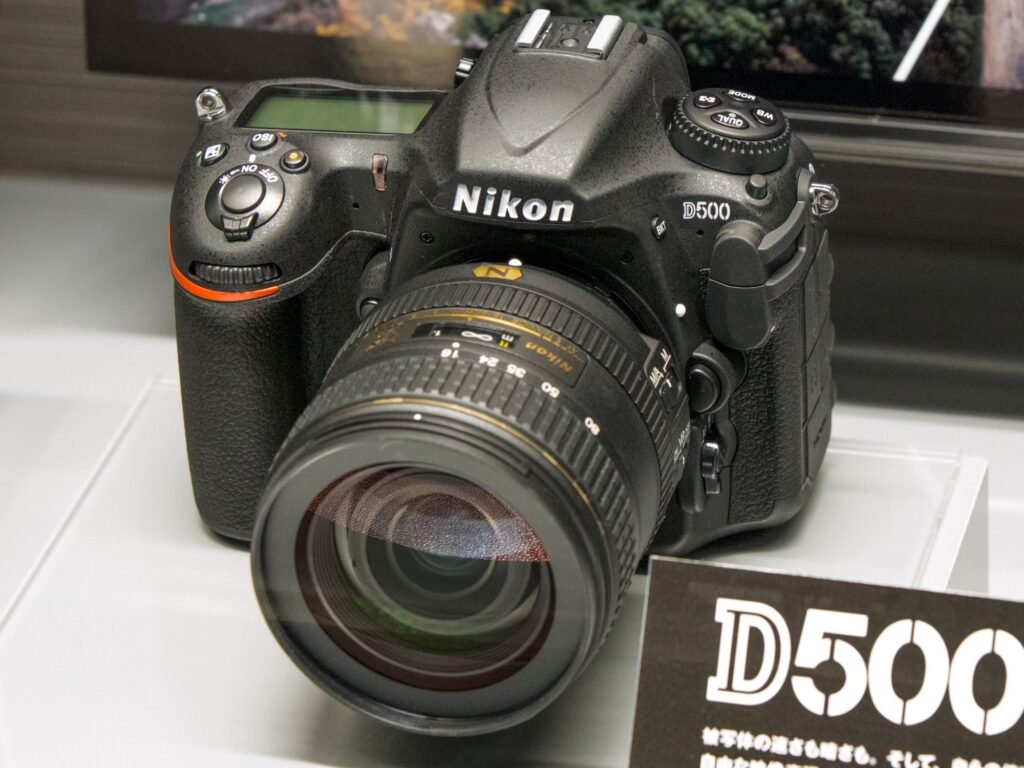
The camera combines a 20.9-megapixel DX-format CMOS sensor with Nikon’s EXPEED 5 image-processing engine, a sophisticated 153-point autofocus system, continuous shooting at up to 10 frames per second, 4K UHD video recording, a large optical viewfinder and a durable weather-sealed body.
One of the D500’s biggest advantages is its autofocus and tracking performance. Its 153-point AF system was designed with professional-level action photography in mind, making it particularly suitable for subjects that move quickly or unpredictably.
The DX sensor also provides a 1.5x crop factor, giving photographers additional apparent reach when using telephoto lenses. This can be extremely useful when photographing birds, wildlife and sports from a distance.
Nikon D500 Overview
The Nikon D500 sits at the high end of Nikon’s DX DSLR lineup. It was designed to deliver professional-style performance in a smaller APS-C/DX-format body.
Unlike entry-level Nikon DSLRs, the D500 emphasizes speed, autofocus performance, durability and extensive manual control.
Its 20.9MP sensor may appear less impressive on paper than higher-resolution APS-C cameras such as the Canon EOS 90D, but the D500 was built around a different priority: fast action and reliable subject tracking.
The camera’s 10 fps burst shooting, large buffer, advanced autofocus system and rugged body make it particularly attractive for wildlife and sports photography.
Nikon D500 Key Specifications
Specification Nikon D500 Camera Type APS-C / DX DSLR Sensor DX-format CMOS Effective Resolution 20.9 MP Sensor Size Approx. 23.5 × 15.7 mm Processor EXPEED 5 Native ISO Range ISO 100–51,200 Expanded ISO Up to ISO 1,640,000 equivalent Autofocus System Multi-CAM 20K AF Points 153 Cross-Type Points 99 Selectable AF Points 55 Maximum Shooting Speed Approx. 10 fps Buffer Up to around 200 JPEG/NEF images under specified conditions Maximum Shutter Speed 1/8000 sec Video 4K UHD Viewfinder Optical pentaprism Viewfinder Coverage Approx. 100% LCD 3.2-inch tilting touchscreen LCD Resolution Approx. 2.36 million dots Storage XQD/CFexpress + SD Connectivity Wi-Fi/Bluetooth via SnapBridge Lens Mount Nikon F Battery EN-EL15 series Weather Resistance Yes Weight Approx. 760g with battery and card
Specifications are based on Nikon’s published D500 information.
20.9MP DX-Format Sensor
The Nikon D500 uses a 20.9-megapixel DX-format CMOS sensor.
Rather than focusing on extremely high pixel counts, Nikon designed the sensor to balance resolution, high-ISO performance and fast data processing.
For wildlife photography, 20.9MP is still enough resolution for detailed images and moderate cropping.
The sensor also works particularly well with Nikon’s long telephoto lenses.
A major advantage is the DX-format crop factor of approximately 1.5x. This gives a narrower field of view than the same lens on a full-frame camera.
For example, a 400mm lens produces a field of view equivalent to approximately 600mm on a full-frame camera.
This is one reason the D500 became so popular among bird and wildlife photographers.
EXPEED 5 Image Processor
The camera uses Nikon’s EXPEED 5 image-processing engine.
The processor handles:
- Image processing
- Noise reduction
- Autofocus calculations
- Continuous shooting
- 4K video processing
- High-ISO image processing
The processing system allows the D500 to maintain fast operation while recording high-quality photographs at 10 frames per second.
High ISO Performance
The D500 has a native ISO range of 100 to 51,200, with expanded settings reaching an equivalent of approximately ISO 1,640,000.
The extremely high expanded settings are designed for situations where capturing an image in very poor light is more important than maintaining maximum image quality.
In normal photography, photographers will generally achieve better results at lower ISO settings.
The D500’s high-ISO capability is particularly valuable for wildlife photographers because animals are often active around dawn, dusk or in shaded environments.
Higher ISO allows the photographer to maintain a sufficiently fast shutter speed when available light is limited.
153-Point Professional Autofocus System
The D500’s autofocus system is arguably its most important feature.
It uses Nikon’s Multi-CAM 20K autofocus sensor module with 153 AF points, including 99 cross-type points. Nikon specifies 55 selectable points within the overall 153-point system.
This sophisticated AF system is designed for tracking moving subjects.
It is particularly useful for:
- Birds in flight
- Wildlife
- Sports
- Motorsports
- Children
- Action photography
- Events
The autofocus system provides multiple area modes, allowing photographers to select an AF configuration appropriate for the subject.
Group-Area AF
For action photography, Nikon’s Group-Area AF mode can be particularly useful.
Instead of relying on a single focus point, the camera can use a group of autofocus points to help maintain focus on the subject.
This can be helpful when photographing:
- Birds against complex backgrounds
- Athletes
- Moving animals
- Vehicles
- Subjects that move unpredictably
The exact effectiveness depends on the subject, lens, lighting and photographer’s technique.
10 FPS Continuous Shooting
The Nikon D500 can shoot at approximately 10 frames per second.
This is one of its biggest advantages for action photography.
A high frame rate increases the chance of capturing the decisive moment.
For example, when photographing a bird taking flight, the photographer can record a sequence containing multiple wing positions rather than relying on a single exposure.
The camera’s large buffer was also an important advantage when it was introduced, allowing photographers to capture long bursts of action.
1/8000 Second Shutter Speed
The D500 provides a maximum shutter speed of 1/8000 second.
This is useful for:
- Fast-moving wildlife
- Sports
- Birds in flight
- Motorsport
- Bright outdoor conditions
- Wide-aperture portrait photography
The fast shutter also helps freeze rapid movement.
Large Optical Viewfinder
The D500 uses a pentaprism optical viewfinder with approximately 100% frame coverage.
The optical finder provides a direct view through the lens, allowing photographers to compose without the electronic display used by mirrorless cameras.
For wildlife and sports photographers, an optical viewfinder can provide a very natural shooting experience.
The large viewfinder also makes it easier to follow moving subjects through the frame.
3.2-Inch Tilting Touchscreen
The camera features a 3.2-inch tilting touchscreen LCD with approximately 2.36 million dots.
The high-resolution display provides a clear way to review photographs and navigate camera menus.
The tilting design is useful for shooting from unusual angles.
It can help when:
- Photographing close to the ground
- Shooting from a low tripod
- Working at waist level
- Recording video
Unlike a fully articulating screen, however, the D500’s display does not rotate completely to the side.
4K UHD Video
The Nikon D500 supports 4K UHD video recording.
It can record 4K UHD footage at up to 30 frames per second, along with Full HD recording at higher frame rates.
The camera also includes features useful to video creators, such as:
- External microphone input
- Headphone output
- HDMI output
- Manual exposure controls
- Flat Picture Control
The D500 is therefore capable of producing high-quality video, although modern mirrorless cameras generally provide a wider selection of advanced video features.
Nikon D500 for Wildlife Photography
Wildlife photography is where the Nikon D500 really stands out.
Its combination of:
- 20.9MP DX sensor
- 1.5x crop factor
- 153-point autofocus
- 10 fps continuous shooting
- High ISO performance
- 1/8000-second shutter
- Large buffer
- Rugged body
- Nikon F-mount telephoto lenses
makes it an excellent wildlife platform.
For bird photographers, the crop factor is particularly useful.
A long telephoto lens can provide substantial reach while keeping the overall system more manageable than an equivalent full-frame setup.
Nikon D500 for Bird Photography
The D500 became especially popular among bird photographers.
Bird photography requires a camera that can handle fast, unpredictable movement.
The D500’s autofocus system can track birds moving across the frame, while the 10 fps burst rate helps capture wing positions and flight moments.
The DX sensor is also advantageous because it provides additional framing reach.
For example, a 600mm lens provides a field of view comparable to approximately 900mm on full frame.
This does not increase the actual optical magnification of the lens, but it allows the subject to occupy more of the captured frame.
Nikon D500 for Sports Photography
The D500 is also well suited to sports.
Its fast burst rate and advanced autofocus system allow photographers to follow athletes during rapid movements.
It can be used for:
- Football
- Cricket
- Tennis
- Basketball
- Athletics
- Motorsports
- Cycling
- School sports
The rugged construction is also useful for photographers who work outdoors in changing conditions.
Nikon D500 for Landscape Photography
Although the D500 is strongly associated with wildlife and action photography, it can also produce excellent landscapes.
Its 20.9MP sensor provides enough resolution for detailed outdoor images.
The DX format can be beneficial when using telephoto lenses to compress distant mountains or isolate landscape details.
For very wide landscape photography, however, photographers need to select an appropriate DX-compatible wide-angle lens.
Nikon D500 for Portrait Photography
The D500 can produce attractive portraits, especially when paired with a fast prime lens.
Because the camera uses an APS-C/DX sensor, photographers can use lenses such as 35mm, 50mm or 85mm to achieve different perspectives.
A fast aperture can provide background separation and help isolate the subject.
For photographers who prefer very shallow depth of field, a full-frame camera may provide additional flexibility.
Nikon D500 for Travel Photography
The D500 is a capable travel camera, especially for photographers who prioritize wildlife and outdoor photography.
Its weather-resistant construction, strong battery performance, high-speed shooting and extensive lens compatibility make it dependable for long trips.
The downside is weight.
The body itself is relatively substantial, and telephoto lenses can add significant weight to a travel kit.
For lightweight travel photography, a modern mirrorless camera may be easier to carry.
Nikon D500 for Street Photography
The D500 can certainly be used for street photography, although its professional DSLR body is larger than many compact mirrorless alternatives.
Its physical controls allow photographers to quickly adjust exposure settings without navigating through menus.
The optical viewfinder is also useful for photographers who prefer a traditional shooting experience.
Nikon D500 Lens Compatibility
The D500 uses the Nikon F-mount.
It is compatible with a large range of Nikon F-mount lenses, including many AF-S and other compatible lenses.
This gives photographers access to lenses for almost every major photographic genre.
Wide-Angle Lenses
Useful for:
- Landscapes
- Architecture
- Travel
- Interiors
Standard Zoom Lenses
Ideal for:
- Everyday photography
- Travel
- Events
- General-purpose shooting
Portrait Lenses
Fast prime lenses can provide:
- Background blur
- Low-light performance
- Portrait-friendly perspective
Telephoto Lenses
Telephoto lenses are especially important for:
- Wildlife
- Birds
- Sports
- Aviation
- Motorsport
The D500’s DX crop factor makes these lenses particularly useful.
XQD and SD Card Support
One unusual feature of the D500 is its use of two different memory-card formats.
It has:
- One XQD card slot
- One SD card slot
Later firmware updates also expanded compatibility of the XQD slot to support CFexpress Type B cards.
This dual-card arrangement can be useful for professional photographers who want to separate different file types or use one card as a backup depending on the configuration.
Photographers purchasing a used D500 should check the firmware version and the exact memory-card configuration they intend to use.
Wi-Fi and Bluetooth Connectivity
The D500 supports wireless connectivity through Nikon’s SnapBridge system.
Bluetooth can be used for a low-power connection with compatible smartphones, while Wi-Fi can support image transfer and remote functions depending on the setup.
Wireless connectivity can be useful for:
- Sharing photographs
- Remote shooting
- Transferring images
- Travel photography
Rugged and Weather-Resistant Body
The D500 was designed for photographers who work in demanding environments.
Its body construction provides a substantial level of durability and weather resistance.
This is important for wildlife photographers because outdoor shoots may involve:
- Dust
- Light rain
- Snow
- Cold temperatures
- Humid environments
Weather resistance does not mean the camera is completely waterproof. A suitable protective approach is still recommended during heavy rain or extreme conditions.
Battery Life
The D500 uses the EN-EL15-series battery family.
Its strong battery performance is another reason the camera is popular with wildlife and outdoor photographers.
Long sessions using optical-viewfinder shooting can be considerably more power-efficient than extensive Live View or video operation.
For professional assignments and long wildlife trips, carrying spare batteries remains a good idea.
Nikon D500 Pros and Cons
Pros
- Excellent 20.9MP DX sensor
- Outstanding autofocus system
- 153 AF points
- 99 cross-type AF points
- Fast 10 fps continuous shooting
- Large image buffer
- Excellent wildlife and bird photography performance
- 1.5x DX crop advantage
- Strong high-ISO performance
- 1/8000-second maximum shutter speed
- Rugged and weather-resistant body
- Large optical viewfinder
- 4K UHD video
- Tilting touchscreen
- Dual memory-card slots
- Extensive Nikon F-mount lens compatibility
- Good battery life
- Professional-style controls
Cons
- Heavy compared with modern APS-C mirrorless cameras
- Lower resolution than cameras such as the Canon EOS 90D
- No built-in sensor-shift image stabilization
- Tilting screen is not fully articulating
- XQD/CFexpress cards can be more expensive than standard SD cards
- Older DSLR autofocus technology compared with the newest mirrorless systems
- Nikon’s current development focus is primarily on mirrorless cameras
Nikon D500 vs Canon EOS 90D
The Canon EOS 90D and Nikon D500 are two of the most interesting APS-C DSLRs.
The Canon offers a much higher 32.5MP resolution, while the D500 uses a 20.9MP sensor.
However, the D500’s greatest strength is its professional-style autofocus system and action-oriented design.
The Canon EOS 90D is attractive for photographers who prioritize resolution and cropping flexibility.
The D500 is particularly compelling for wildlife and sports photographers who prioritize autofocus, tracking, burst shooting and rugged handling.
Nikon D500 vs Pentax K-3 Mark III
Both cameras are premium APS-C DSLRs.
The Pentax K-3 Mark III offers 25.7MP resolution, five-axis in-body stabilization and approximately 12 fps shooting.
The Nikon D500 has a 20.9MP sensor, 10 fps shooting and a highly regarded 153-point autofocus system.
For wildlife and sports photography, both are strong choices.
The Pentax has the advantage of in-body stabilization, while the D500 benefits from Nikon’s mature F-mount ecosystem and excellent action-oriented autofocus.
Nikon D500 vs Nikon D7500
The D7500 is a more compact and affordable DX DSLR positioned below the D500.
The D500 offers:
- More sophisticated autofocus
- More AF points
- Faster professional-oriented operation
- Larger buffer
- Dual card slots
- More rugged construction
- Higher-end controls
The D7500 can be a better choice for enthusiasts who do not need the D500’s professional-level action features.
For serious wildlife and sports photographers, the D500 remains the stronger option.
Is Nikon D500 Still Worth Buying?
Yes—especially for wildlife and sports photographers who find a good-condition used body.
The D500 remains a very capable still-photography camera because its core strengths are not dependent on having the newest sensor technology.
Its autofocus, 10 fps shooting, DX crop factor, buffer, durability and telephoto lens compatibility remain useful today.
The biggest reason to hesitate is the age of the platform.
Nikon’s newer mirrorless Z cameras offer more modern autofocus, subject recognition, video capabilities and a forward-looking lens ecosystem.
Therefore, a new photographer building a system from scratch should compare the D500 with current mirrorless alternatives.
An existing Nikon DSLR owner with F-mount telephoto lenses may find the D500 particularly attractive.
Who Should Buy the Nikon D500?
The D500 is ideal for:
- Wildlife photographers
- Bird photographers
- Sports photographers
- Aviation photographers
- Motorsport photographers
- Outdoor photographers
- Nikon DSLR users
- Advanced enthusiasts
- Professional photographers who prefer DSLRs
- Photographers with Nikon F-mount telephoto lenses
Who Should Avoid the Nikon D500?
Consider a newer mirrorless camera if you:
- Want the latest subject-recognition autofocus
- Need advanced video features
- Want in-body image stabilization
- Prefer a lightweight camera
- Want an electronic viewfinder
- Are building a completely new Nikon system
- Need the latest connectivity and processing technologies
Final Verdict
The Nikon D500 is a DSLR built around speed, autofocus and reliability rather than maximum megapixel count.
Its 20.9MP DX sensor may not have the highest resolution in its class, but it provides enough detail for serious photography while allowing the camera to deliver excellent action performance.
The combination of 153 autofocus points, 10 fps continuous shooting, a large buffer, 1.5x DX crop factor, high-ISO capability and rugged construction makes the D500 especially strong for wildlife and sports photography.
For bird photographers, the camera’s DX format and compatibility with Nikon’s extensive telephoto lens lineup are particularly valuable.
Its biggest weakness is that it belongs to an older DSLR generation. Newer mirrorless cameras can provide more advanced subject detection, stabilization and video functionality.
Nevertheless, for photographers who specifically want a professional-grade APS-C DSLR, the D500 remains one of Nikon’s most impressive DX cameras.
Nikon D500 Rating
Category Rating Image Quality 9/10 Autofocus 9.5/10 Continuous Shooting 9.5/10 Low-Light Performance 9/10 Video 8/10 Build Quality 9.5/10 Battery Life 9/10 Wildlife Photography 10/10 Sports Photography 9.5/10 Travel Photography 8/10 Overall 9.3/10
Frequently Asked Questions
1. Is the Nikon D500 a full-frame camera?
No. The Nikon D500 is a DX-format APS-C DSLR.
2. How many megapixels does the Nikon D500 have?
The D500 has approximately 20.9 effective megapixels.
3. Is Nikon D500 good for wildlife photography?
Yes. It is particularly well suited to wildlife and bird photography because of its autofocus system, 10 fps burst rate, DX crop factor and extensive telephoto lens compatibility.
4. How many autofocus points does the D500 have?
The camera’s Multi-CAM 20K autofocus system has 153 AF points, including 99 cross-type points.
5. How fast can the Nikon D500 shoot?
The D500 can shoot at approximately 10 frames per second.
6. What is the maximum ISO of the D500?
Its standard ISO range is 100–51,200, with expanded settings reaching an equivalent of approximately ISO 1,640,000.
7. Does the Nikon D500 record 4K video?
Yes. The D500 supports 4K UHD video recording.
8. Does the D500 have image stabilization?
The camera body does not have sensor-shift in-body image stabilization. Stabilization depends on compatible lenses that provide optical VR.
9. What memory cards does the Nikon D500 use?
The camera has one XQD-compatible slot and one SD card slot. With compatible firmware, the XQD slot can also support CFexpress Type B cards.
10. What lens mount does the Nikon D500 use?
The D500 uses the Nikon F mount and supports a wide range of compatible F-mount lenses.
11. Is the Nikon D500 weather sealed?
The D500 is designed with dust- and weather-resistant construction, making it suitable for demanding outdoor photography when used appropriately.
12. Is Nikon D500 still worth buying?
Yes, particularly for wildlife, bird and sports photography. It can be an excellent used DSLR, although photographers starting a new system should also consider Nikon’s newer mirrorless Z cameras.