Nikon D7500 Review: A Powerful APS-C DSLR for Enthusiast Photographers
The Nikon D7500 is a versatile DX-format DSLR designed for photographers who want strong image quality, fast performance, reliable autofocus and traditional DSLR handling without moving into the more expensive professional range.
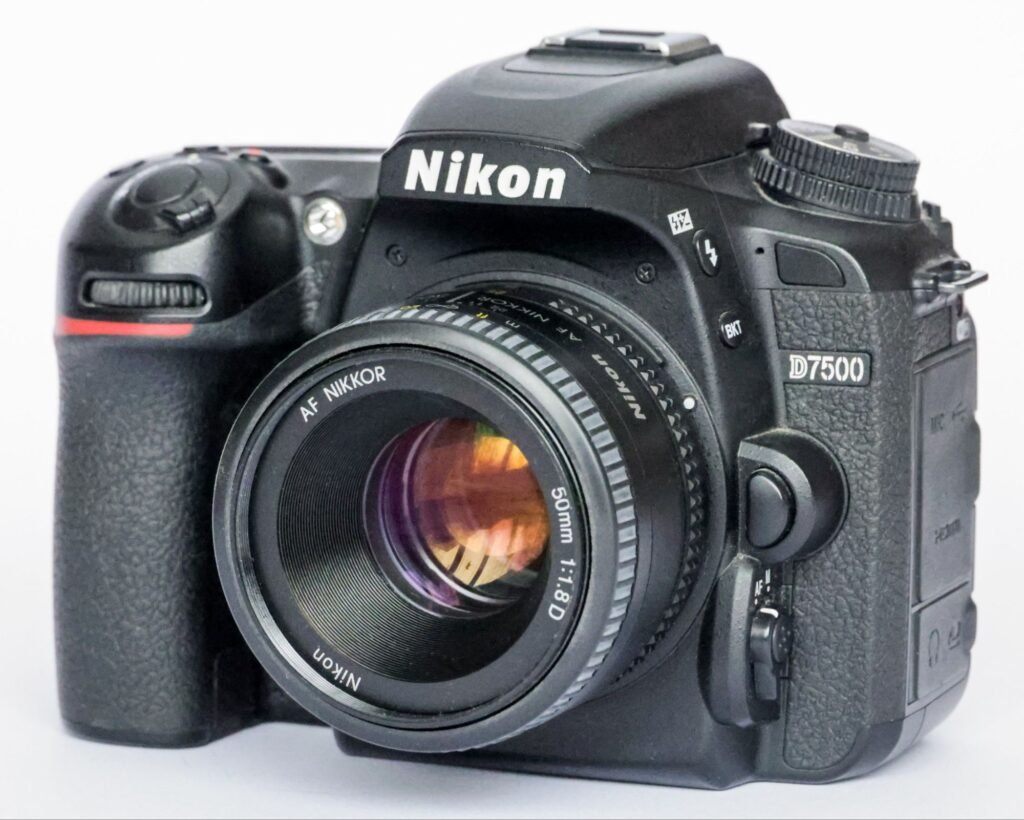
Featuring a 20.9-megapixel DX-format CMOS sensor, Nikon’s EXPEED 5 image processor, a 51-point autofocus system, continuous shooting at up to 8 frames per second, 4K UHD video and a rugged weather-sealed body, the D7500 remains a capable camera for everyday photography and demanding outdoor work.
The camera is particularly well suited to wildlife, travel, sports, portraits, landscapes and general enthusiast photography. Its 1.5x DX crop factor also provides additional framing reach when using telephoto lenses, making it useful for photographing birds and distant subjects.
Although Nikon’s modern camera development has shifted strongly toward mirrorless Z-series cameras, the D7500 remains an attractive option for photographers who prefer an optical viewfinder and already own Nikon F-mount lenses.
Nikon D7500 Overview
The Nikon D7500 was introduced as a successor to the popular D7200. It sits below the professional-oriented D500 while sharing some important technology with that camera.
Instead of using a very high-resolution sensor, Nikon chose a 20.9MP sensor that emphasizes a balance between image quality, high-ISO performance and processing speed.
The D7500 also uses the EXPEED 5 processor, which helps it deliver faster continuous shooting and improved high-ISO performance compared with older Nikon DX cameras.
Its compact DSLR body makes it easier to carry than larger professional models while still providing substantial physical controls and a comfortable grip.
Nikon D7500 Key Specifications
Specification Nikon D7500 Camera Type APS-C / DX DSLR Sensor DX-format CMOS Effective Resolution 20.9 MP Sensor Size Approx. 23.5 × 15.7 mm Processor EXPEED 5 Native ISO Range ISO 100–51,200 Expanded ISO Up to ISO 1,640,000 equivalent Autofocus System Multi-CAM 3500 II AF Points 51 Cross-Type Points 15 Maximum Shooting Speed Approx. 8 fps Maximum Shutter Speed 1/8000 sec Video 4K UHD Viewfinder Optical pentaprism Viewfinder Coverage Approx. 100% LCD 3.2-inch tilting touchscreen LCD Resolution Approx. 922,000 dots Storage Single SD card slot Connectivity Wi-Fi/Bluetooth Lens Mount Nikon F Battery EN-EL15a / compatible EN-EL15 series Weather Resistance Yes Weight Approx. 720g with battery and card
Specifications are based on Nikon’s published D7500 information.
20.9MP DX Sensor
The Nikon D7500 uses a 20.9-megapixel DX-format CMOS sensor.
Although some competing APS-C cameras offer more megapixels, Nikon’s approach provides a good balance between resolution and high-ISO performance.
Twenty megapixels is enough for:
- Wildlife photography
- Portraits
- Landscapes
- Travel
- Street photography
- Sports
- Events
- Social media
- Large prints
The sensor also provides enough flexibility for moderate cropping.
For wildlife photographers, the DX format is particularly useful because it provides a narrower field of view compared with full-frame cameras.
1.5x DX Crop Factor
The D7500’s DX sensor provides an approximately 1.5x crop factor relative to full frame.
This is particularly helpful for photographers using telephoto lenses.
For example, a 300mm lens gives a field of view comparable to approximately 450mm on a full-frame camera.
This does not actually change the physical focal length of the lens, but the smaller sensor captures a narrower portion of the image circle.
For wildlife and bird photographers, this can make distant subjects appear larger within the captured frame.
EXPEED 5 Image Processor
The camera uses Nikon’s EXPEED 5 image-processing engine.
The processor manages:
- Image processing
- Noise reduction
- Autofocus calculations
- Continuous shooting
- 4K video
- High-ISO processing
It allows the D7500 to provide faster performance than many previous-generation DX DSLRs.
ISO Performance
The D7500 offers a native ISO range of 100–51,200, with expanded settings reaching an equivalent of approximately ISO 1,640,000.
The very high expanded ISO settings are intended for extreme low-light situations where recording an image is more important than maintaining maximum image quality.
For everyday photography, lower ISO values generally produce cleaner images.
The camera’s high-ISO capability can be especially useful for:
- Indoor events
- Night photography
- Wildlife at dawn or dusk
- Sports in poor lighting
- Concerts
- Street photography
When photographing fast-moving subjects, higher ISO can allow the photographer to maintain a faster shutter speed.
51-Point Autofocus System
The Nikon D7500 uses a 51-point Multi-CAM 3500 II autofocus system.
The system includes 15 cross-type sensors and is designed to provide dependable autofocus across a variety of shooting situations.
It can be used for:
- Portrait photography
- Wildlife
- Sports
- Travel
- Events
- Street photography
- Moving subjects
The camera offers several autofocus-area modes, allowing photographers to choose between single-point focusing and various dynamic-area configurations.
Group-Area AF
The D7500 also provides Group-Area AF, which can be useful when photographing subjects that move unpredictably.
Instead of relying entirely on one focus point, photographers can use multiple points to help maintain focus.
This can be useful for:
- Birds
- Athletes
- Moving animals
- Vehicles
- Children
- Outdoor action
The photographer’s choice of AF mode remains important because different subjects require different focusing strategies.
8 FPS Continuous Shooting
The Nikon D7500 can shoot at approximately 8 frames per second.
This makes it considerably more capable for action photography than entry-level DSLRs.
The 8 fps burst rate can help capture:
- Birds in flight
- Wildlife movement
- Sports action
- Children playing
- Dancing
- Vehicles
- Outdoor events
For serious professional sports photography, the higher-end D500 or modern mirrorless cameras can provide more advanced action capabilities.
For enthusiasts, however, 8 fps is fast enough for many real-world situations.
1/8000 Second Shutter Speed
The D7500 offers a maximum shutter speed of 1/8000 second.
This is useful when photographing fast subjects or using wide apertures in bright sunlight.
For example, a portrait photographer using a fast prime lens can use a high shutter speed to maintain a wide aperture outdoors.
Wildlife photographers can also use fast shutter speeds to freeze rapid animal movement.
Optical Pentaprism Viewfinder
The D7500 uses an optical pentaprism viewfinder with approximately 100% frame coverage.
This is one of the key advantages of using a DSLR.
The optical viewfinder provides a direct view through the lens, without the electronic processing required by an electronic viewfinder.
Many photographers prefer this experience for:
- Wildlife
- Sports
- Street photography
- Events
- Portraits
The viewfinder also allows photographers to follow moving subjects naturally.
3.2-Inch Tilting Touchscreen
The D7500 features a 3.2-inch tilting touchscreen LCD.
The screen can tilt upward and downward, which makes it useful when photographing from low or high angles.
The touchscreen also provides convenient access to:
- Menu controls
- Image playback
- Focus selection
- Live View controls
- Camera settings
It is not a fully articulating screen, so it cannot rotate completely toward the front of the camera.
4K UHD Video
The Nikon D7500 supports 4K UHD video recording.
It can record 4K footage at up to 30 frames per second.
The camera also supports Full HD recording at higher frame rates for slow-motion footage.
Video features include:
- 4K UHD
- Full HD
- External microphone input
- Headphone monitoring
- Manual exposure controls
- HDMI output
- Picture Control options
For photographers who occasionally create video content, the D7500 is versatile.
However, modern mirrorless cameras generally provide more advanced video autofocus and video-specific features.
Nikon D7500 for Wildlife Photography
The D7500 is a strong wildlife camera for enthusiasts.
Its combination of:
- 20.9MP sensor
- 1.5x DX crop factor
- 8 fps continuous shooting
- 51-point autofocus
- High ISO performance
- 1/8000-second shutter
- Nikon F-mount telephoto lenses
makes it capable of handling many wildlife situations.
The crop factor is particularly useful when photographing animals that are far away.
A 500mm lens, for example, provides a field of view comparable to approximately 750mm on a full-frame camera.
This can help the photographer fill the frame without requiring an even longer lens.
Nikon D7500 for Bird Photography
Bird photography is one of the D7500’s strongest applications.
Birds are often small and distant, so the combination of a DX sensor and telephoto lens is useful.
The 8 fps burst rate can also help capture different wing positions during flight.
For photographers who want to photograph birds without investing in the larger D500, the D7500 can provide an excellent balance between price, size and performance.
However, photographers who regularly shoot fast birds in difficult conditions may benefit from the D500’s more sophisticated autofocus system or a newer mirrorless camera.
Nikon D7500 for Sports Photography
The D7500 is capable of handling many types of sports photography.
Its 8 fps shooting rate provides enough speed to capture sequences of action.
It can be used for:
- Cricket
- Football
- Tennis
- Basketball
- Athletics
- Cycling
- Motorsport
- School sports
A suitable telephoto zoom can make the D7500 a flexible sports system.
Nikon D7500 for Portrait Photography
The D7500 can produce detailed and attractive portraits.
Because it uses an APS-C sensor, photographers can use lenses such as 35mm, 50mm and 85mm to achieve different portrait perspectives.
A fast-aperture prime lens can provide background separation and attractive bokeh.
The camera’s high ISO capability is also useful for indoor portraits where available light is limited.
Nikon D7500 for Landscape Photography
The D7500 is capable of producing high-quality landscape photographs.
Its 20.9MP sensor captures enough detail for most enthusiast applications.
A wide-angle DX lens can provide a broad field of view for:
- Mountains
- Beaches
- Forests
- Architecture
- Cityscapes
- Travel scenes
For photographers who frequently print very large images or need extensive cropping, higher-resolution cameras may offer additional flexibility.
Nikon D7500 for Travel Photography
The D7500 can be a very practical travel camera.
Its DSLR body is smaller than the professional D500, while still providing good ergonomics and physical controls.
The camera’s strong battery performance, weather-resistant construction and broad F-mount lens selection are useful for long trips.
The main disadvantage is that the overall camera-and-lens kit can become heavy compared with modern mirrorless systems.
Nikon D7500 for Street Photography
The D7500 can also be used for street photography.
Its optical viewfinder and physical dials allow photographers to make exposure adjustments without relying heavily on menus.
However, its DSLR body is relatively large compared with compact mirrorless cameras.
Photographers who value discreet, lightweight equipment may prefer a smaller system.
Nikon D7500 Lens Compatibility
The Nikon D7500 uses the Nikon F mount.
It is compatible with a wide selection of Nikon lenses, including many AF-S and other compatible F-mount optics.
This provides photographers with options for nearly every major photographic genre.
Wide-Angle Lenses
Best for:
- Landscapes
- Architecture
- Travel
- Interiors
Standard Zoom Lenses
Useful for:
- Everyday photography
- Travel
- Events
- Family photography
Prime Lenses
Fast prime lenses are useful for:
- Portraits
- Street photography
- Low-light photography
- Background blur
Telephoto Lenses
Especially useful for:
- Wildlife
- Birds
- Sports
- Aviation
- Motorsport
Single SD Card Slot
Unlike the Nikon D500, the D7500 has one SD memory-card slot.
For casual and enthusiast photographers, this is usually sufficient.
However, professionals who require automatic backup during important assignments may prefer a camera with dual card slots.
For weddings and paid events, photographers should consider a reliable memory card and a separate backup workflow.
Wi-Fi and Bluetooth
The D7500 supports Bluetooth and Wi-Fi connectivity through Nikon’s SnapBridge ecosystem.
These features can make it easier to:
- Transfer photographs
- Connect to a smartphone
- Share images
- Remotely control the camera
Wireless connectivity can be particularly useful during travel when photographers want to share images quickly.
Weather-Resistant Construction
The D7500 has a durable body designed for outdoor use and features weather-resistant construction.
This makes it suitable for many outdoor environments.
Wildlife and travel photographers can benefit from additional protection against:
- Dust
- Light rain
- Moisture
- Cold conditions
However, weather resistance does not mean the camera is completely waterproof. Appropriate protection should still be used during heavy rain or extreme conditions.
Battery Life
The D7500 uses the EN-EL15-series battery family.
Its battery performance is suitable for extended photography sessions, particularly when shooting primarily through the optical viewfinder.
Extensive Live View, Wi-Fi use and video recording can reduce battery life.
For long travel trips, wildlife sessions or professional assignments, carrying a spare battery is recommended.
Nikon D7500 Pros and Cons
Pros
- Excellent 20.9MP DX sensor
- Strong high-ISO performance
- Fast 8 fps continuous shooting
- Reliable 51-point autofocus system
- 15 cross-type AF points
- 1.5x DX crop advantage
- Excellent for wildlife and bird photography
- 1/8000-second shutter speed
- Large optical pentaprism viewfinder
- 4K UHD video
- Tilting touchscreen
- Wi-Fi and Bluetooth
- Good battery life
- Weather-resistant construction
- Comfortable DSLR handling
- Extensive Nikon F-mount lens compatibility
Cons
- Only one SD card slot
- No in-body image stabilization
- Larger and heavier than many mirrorless alternatives
- Lower resolution than Canon EOS 90D
- Autofocus tracking is less advanced than the newest mirrorless cameras
- Tilting screen is not fully articulating
- Older DSLR platform
- Nikon’s current development focus is primarily on mirrorless Z cameras
Nikon D7500 vs Nikon D500
The D500 is the more professional-oriented camera.
It offers a more sophisticated 153-point autofocus system, 10 fps continuous shooting, a larger buffer, dual memory-card support and a more rugged design.
The D7500 is smaller, lighter and generally easier to carry.
For serious wildlife and sports photographers, the D500 is the stronger choice.
For enthusiasts who want excellent DX image quality without needing the D500’s professional features, the D7500 can provide better value.
Nikon D7500 vs Canon EOS 90D
The Canon EOS 90D offers a substantially higher 32.5MP resolution compared with the D7500’s 20.9MP.
The Canon also offers 10 fps shooting, while the D7500 provides 8 fps.
However, the D7500 has excellent high-ISO performance and remains attractive to Nikon F-mount users.
Choose the EOS 90D if maximum resolution and cropping flexibility are priorities.
Choose the D7500 if you already own Nikon lenses or prefer Nikon’s DSLR controls and handling.
Nikon D7500 vs Pentax K-3 Mark III
The Pentax K-3 Mark III is a newer premium APS-C DSLR.
It offers higher resolution, faster continuous shooting and five-axis in-body image stabilization.
The D7500 is older but has access to Nikon’s extensive F-mount lens ecosystem.
The Pentax is particularly attractive for photographers who want in-body stabilization and rugged DSLR construction.
The Nikon can be a better choice for existing Nikon users with a collection of compatible lenses.
Nikon D7500 vs Nikon D7200
The D7500 is an important upgrade over the D7200.
It introduces the newer 20.9MP sensor and EXPEED 5 processor, provides faster 8 fps shooting and adds a tilting touchscreen.
The D7200 offers dual SD card slots, which the D7500 does not.
Therefore, photographers who need dual-card redundancy may still find the older D7200 interesting.
For speed, processing and overall modern operation, the D7500 is generally the stronger camera.
Is Nikon D7500 Still Worth Buying?
Yes, particularly as a used DSLR.
The D7500 still provides an excellent combination of image quality, speed, autofocus and ergonomics.
Its biggest advantage today is value.
Photographers can often find used DSLR bodies and F-mount lenses at attractive prices compared with newer mirrorless equipment.
The main consideration is long-term system development.
Nikon is now concentrating heavily on its Z-mount mirrorless system, so photographers starting from scratch should compare the D7500 with current Nikon Z cameras before investing heavily in F-mount equipment.
For someone who already owns Nikon F lenses, however, the D7500 remains a practical and capable upgrade.
Who Should Buy the Nikon D7500?
The camera is ideal for:
- Enthusiast photographers
- Advanced beginners
- Wildlife photographers
- Bird photographers
- Travel photographers
- Sports photographers
- Portrait photographers
- Landscape photographers
- Nikon DSLR users
- Photographers with F-mount lenses
- Hobby photographers
- Outdoor photographers
Who Should Avoid the Nikon D7500?
A newer mirrorless camera may be a better choice if you:
- Want the latest subject-detection autofocus
- Need advanced video capabilities
- Want in-body image stabilization
- Prefer a lightweight camera
- Need dual card slots
- Want an electronic viewfinder
- Are building a completely new Nikon system
- Want the newest lens technology
Final Verdict
The Nikon D7500 remains a highly capable APS-C DSLR for photographers who value traditional camera handling and strong still-image performance.
Its 20.9MP DX sensor, EXPEED 5 processor, 51-point autofocus system, 8 fps continuous shooting, 1.5x crop factor and 4K video provide a versatile combination for enthusiast photography.
The camera is especially appealing for wildlife and bird photography. The DX format provides additional framing reach with telephoto lenses, while the 8 fps burst rate can capture fast-moving subjects.
The D7500 is also capable of handling portraits, landscapes, travel, sports and everyday photography.
Its limitations are mainly related to its age. Modern mirrorless cameras offer more advanced subject recognition, in-body stabilization, video features and electronic viewfinders.
Nevertheless, for an existing Nikon DSLR owner—or anyone looking for an affordable, capable used DSLR—the D7500 remains a very good option.
Nikon D7500 Rating
Category Rating Image Quality 9/10 Autofocus 8.5/10 Continuous Shooting 8.5/10 Low-Light Performance 9/10 Video 8/10 Build Quality 9/10 Battery Life 9/10 Wildlife Photography 9/10 Sports Photography 8.5/10 Travel Photography 8.5/10 Overall 8.9/10
Frequently Asked Questions
1. Is the Nikon D7500 a full-frame camera?
No. The D7500 is a DX-format APS-C DSLR.
2. How many megapixels does the Nikon D7500 have?
The D7500 has approximately 20.9 effective megapixels.
3. Is the Nikon D7500 good for wildlife photography?
Yes. Its DX crop factor, 8 fps shooting, 51-point autofocus system and compatibility with Nikon telephoto lenses make it a strong wildlife camera.
4. How fast can the Nikon D7500 shoot?
The D7500 can shoot at approximately 8 frames per second.
5. What is the maximum ISO of the D7500?
Its native ISO range is 100–51,200, with expanded settings reaching an equivalent of approximately ISO 1,640,000.
6. Does the Nikon D7500 record 4K video?
Yes. It supports 4K UHD video recording.
7. Does the Nikon D7500 have image stabilization?
The D7500 body does not have sensor-shift in-body image stabilization. Stabilization depends on compatible lenses equipped with Nikon VR.
8. How many autofocus points does the D7500 have?
The D7500 uses a 51-point autofocus system, including 15 cross-type points.
9. Does the D7500 have Wi-Fi?
Yes. The camera supports Wi-Fi and Bluetooth connectivity through Nikon’s SnapBridge system.
10. Does the Nikon D7500 have a touchscreen?
Yes. It features a 3.2-inch tilting touchscreen LCD.
11. What lens mount does the D7500 use?
The D7500 uses the Nikon F mount and supports a broad range of compatible F-mount lenses.
12. Is the Nikon D7500 still worth buying?
Yes, particularly as a used DSLR. It remains capable for wildlife, travel, sports, portraits and general photography, although buyers starting a new system should also consider Nikon’s newer Z-mount mirrorless cameras.